Anyone who has run an event through an Australian spring has watched a frame tent lift at one corner and understood immediately what the specifications were describing. Rain is an inconvenience. Wind is what writes off equipment, and in most of the country the gust that does it arrives with very little warning.
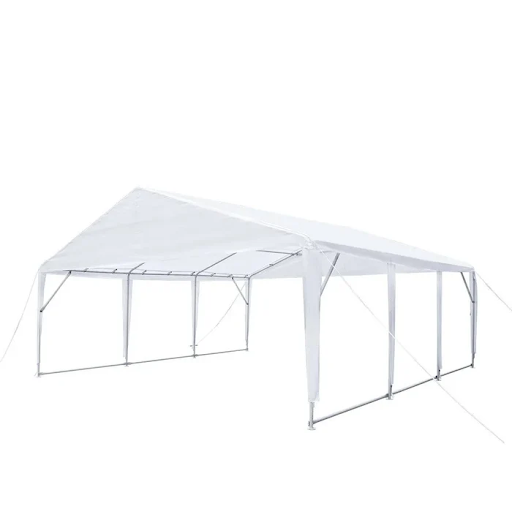
A 6 x 6 m outdoor party tent is a large sail held down by whatever happens to be at its feet. Fabric weight and frame spacing describe how much load it can carry, and the anchoring describes whether that load ever reaches the ground.
Why Fabric Is Specified by Grams
Weight Predicts Tear Strength
Polyethylene tarpaulin is quoted in grams per square metre because that figure predicts tear strength and service life better than thickness does. A heavier fabric resists the tearing that starts at an eyelet and runs across a panel.
Drumming Is What Kills a Cover
Fabric loose enough to move flexes at every fixing point, and the fatigue accumulates until a seam or an eyelet lets go. That is why re-tensioning matters more than most owners expect, and why a slack cover is already a damaged one.
Ultraviolet Stabilisation
Unstabilised polyethylene turns brittle within a season of high sun exposure, and the failure arrives as sudden splitting rather than gradual wear. A rated cover carries a stated life, which is the honest basis for comparison between products.
Welded Against Stitched Seams
Welded seams remove the needle holes that leak and the thread that rots. On a cover this size that difference accounts for most of the durability gap between a cheap unit and a serviceable one.
Bracing and the Uplift Problem
The Force Lifts Rather Than Pushes
Wind over a marquee roof lowers the pressure above it while the pressure underneath stays the same. That is why pegs are specified by withdrawal resistance and why ballast weights are quoted in kilograms per leg.
Diagonals Stop the Fold
Bracing between the legs is what prevents the frame folding sideways once a corner starts to move. A frame with braced bays behaves as a box, while one relying on friction at the joints racks and then collapses in sequence.
Section Over Height
A thin-wall tube of generous diameter looks substantial and then buckles at a joint under side load. Wall thickness matters more than overall height on a marquee frame, and that failure is permanent rather than something which springs back once the wind drops.
Setting Up on Different Ground
Where the structure stands decides the anchoring method entirely.
The practical split looks like this:
- Grass: long pegs driven at an angle away from load
- Dry or sandy soil: far less hold than peg length suggests
- Concrete or pavers: ballast at every leg, not corners
- Any surface: narrow face to the prevailing wind
Dry summer ground and loose sand both give far less than the peg length suggests, which is the most common reason a well-pegged marquee still lifts. On hardstand, pegging is simply not available and weight per leg becomes a calculation rather than a guess.
Partial enclosure changes the loading in a way that catches people out. Walls on one or two sides let wind in with nowhere to escape, which raises internal pressure and increases uplift, so an outdoor tent with all walls fitted or none behaves more predictably than one half dressed.
Packing Down and Storing It
Damp Fabric Grows Mould
Mould on polyethylene is a permanent stain that becomes a weak point. The accepted practice is to dry the cover before storage, and where that is impossible, to unpack and dry it within a day or two rather than next season.
Frames Want to Be Dry Too
Water sitting inside a tube corrodes it from the inside where nobody looks, and a galvanised frame stored wet still fails at the joints. Draining the legs before packing takes a minute and is routinely skipped.
Label the Bags
A frame with several similar-looking lengths becomes a puzzle once the parts are mixed. A structure that takes two hours to work out gets used less often than one taking twenty minutes, which is a real cost rather than a tidiness point.
Where Event Structures Are Going
Heavier fabric grades and welded seams have become standard across the mid range, and ballast systems sold with the structure rather than improvised on site are now common. Engineered pegging schedules, long normal for commercial hire, are appearing in domestic product documentation.
For a buyer the useful comparison is fabric grade and bracing rather than footprint. A shade sail on the same ground answers to identical physics, and TMG Industrial lists fabric weight, frame section and anchoring requirements together so those can be read against the site.