Contractors through the Midwest and Northeast compress their earthwork into the months between thaw and freeze, which puts a premium on equipment that finishes a lift in one pass rather than three. That pressure is why the heavier end of the plate compactor range exists.
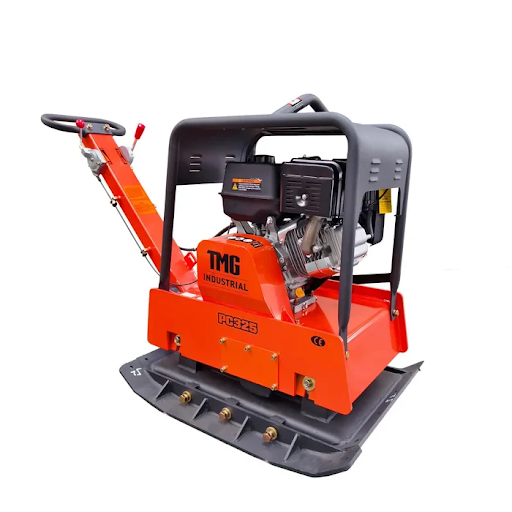
Buyers in that range should be reading force figures rather than machine weights. A 8500 lbs reversible plate compactor generates far more force than its own mass, and that multiplication is the entire mechanism behind why it outperforms a small roller on granular backfill.
How a Vibrating Plate Densifies Soil
Weight Presses, Vibration Rearranges
A rotating eccentric mass generates centrifugal force many times the machine’s own weight. That force momentarily reduces friction between soil particles so they can slide past one another into a denser arrangement, and static weight on its own simply cannot do that at any mass.
Which Number to Compare
The headline figure worth comparing across machines is centrifugal force rather than mass. A machine at a given weight with a higher force output reaches deeper and finishes a lift in fewer passes, while a heavier machine with a weak exciter can ride on top of loose granular material.
Frequency Against Amplitude
Higher frequency with lower amplitude works the top of the layer and gives a tight finished surface. Lower frequency with higher amplitude drives energy further down, which is why a light machine can produce a lovely-looking surface over soil that was never properly densified underneath.
Why Reversible Travel Exists
Carrying It Back Is Not an Option
A single-direction walk behind compactor has to be lifted and returned to the start of each pass. At this weight class nobody does that repeatedly, so the twin-eccentric arrangement is what makes the machine usable rather than merely powerful.
The Third Mode Matters Most
Holding the plate stationary while it vibrates concentrates energy in one spot, which is exactly what trench ends and the ground against a foundation wall need. A roller cannot do this at all, and that is the clearest dividing line between the two.
The Speed Penalty
A heavy walk behind compactor moves slowly by design, because forward speed and compactive effort trade directly against each other. On a long open run that slowness hands the job to a roller regardless of how much force the plate can generate.
Lift Thickness Sets the Pass Count
Compaction reaches a finite depth, and past that depth the material simply does not densify. Lift thickness therefore has to be matched to the machine rather than the machine asked to cover an ambitious lift, which is where settlement complaints originate.
A short field routine prevents most of them:
- Limit lift thickness to what the machine can reach
- Overlap passes by about a third of plate width
- Check moisture by hand feel before each lift
- Test density on the first lift, then count passes
A vibratory compactor at this force class reaches considerably deeper than a light plate, which is the reason to buy one. Moisture sets the ceiling regardless, because every soil has an optimum content at which it reaches its highest achievable density for a given effort.
Hard Surfaces and Operator Exposure
Water Is Functional on Asphalt
Bitumen sticks to a dry plate and tears the mat, so a water tank feeding the plate surface is a functional requirement rather than an accessory on any machine intended for paving work. Soil compaction specifications on hard surfaces are usually written against a roller, which is worth knowing before quoting.
Vibration Is a Health Hazard
Hand-arm vibration exposure from a walk behind compactor is cumulative and regulated in most jurisdictions, and the defense is an isolated handle rather than gloves. Published vibration figures exist for exactly this reason and are worth comparing across machines.
Run-Away Is the Mechanical One
A reversible machine moving toward an operator who has misread the control is the classic incident in this category. A handle-mounted control that returns to neutral when released is what prevents it, and confirming that behavior on the machine beats comparing force ratings on paper.
Transport and Lifting
A machine this heavy needs a lifting point rated for it and a vehicle that can genuinely take the weight. A compactor plate shifting on a trailer is dangerous to everyone behind it, so tie-down points belong on the specification list rather than being improvised at the yard.
Where Compaction Is Heading
Intelligent compaction, where the machine measures ground stiffness and reports coverage, has moved from large rollers down toward plates. Remote-controlled trench compactors are now common on utility work where operator exposure is the concern, and both changes target the weaknesses above rather than adding force.
For a contractor the conclusion is that force output, frequency and plate size describe what a machine will do, while operating weight describes what it takes to move it. TMG Industrial publishes all four together, which makes a machine matchable to a lift thickness rather than to a price point.