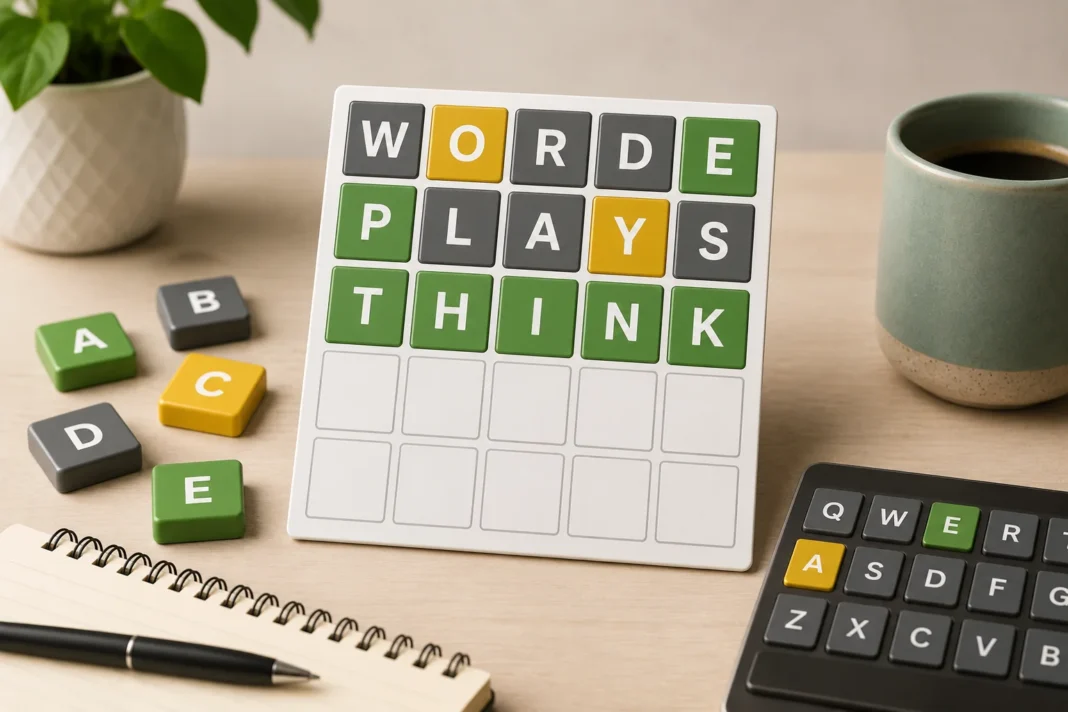
Wordle gives you six chances to guess a five-letter word. Most players finish in four or five. Consistent solvers — the ones posting green squares daily — average between 3.3 and 3.6 guesses. The gap between those two outcomes is not vocabulary. It is a strategy.
This guide covers everything: how to pick a strong opening word, how to read tile feedback precisely, what to do when you are stuck between two plausible answers, and how Hard Mode changes the rules. A full annotated solve walkthrough is included so you can see the logic applied in real time. See today’s Wordle hints.
What Makes Wordle Harder Than It Looks
The rules appear simple. Guess a five-letter word, read the tile colors, repeat up to six times. But the answer pool contains around 2,300 words, many of them belonging to families of look-alike options — words that share four letters and differ only in one position. That is where most streaks end. Players reach guess five with three plausible candidates and no efficient way to resolve them.
The game also has structural traps. Certain letter patterns like -OUND or -IGHT fit eight or nine words simultaneously. Get caught in one of those families late without a way out, and you are guessing blind. Understanding the puzzle’s underlying structure is what separates a method from a habit.
How to Think About Every Guess (The Information Framework)
The single most useful mental shift in this Wordle strategy guide is this: every guess is a data-collection exercise, not an attempt to solve the puzzle.
Your job on Guess One is not to find the answer. The odds of solving it on the first try are roughly 1 in 2,300. Your job is to eliminate as many wrong letters and positions as possible so that the answer pool collapses quickly. A guess that reduces 2,300 possible answers down to 60 is a good first guess, even if every tile comes back grey.
Apply this logic across every turn:
- Guess 1: Maximum diagnostic coverage — test the highest-frequency letters
- Guess 2: Respect all feedback from Guess 1 — introduce new high-value letters
- Guess 3: Work the remaining pool — use pattern recognition and elimination
- Guess 4+: Target the answer directly, or play a scout guess if multiple candidates remain
The players who consistently solve in three are not smarter. They just treat each turn as a question rather than an answer.
Your First Guess: The Best Wordle Starting Words
Your opener should do three things: test two or three vowels, cover high-frequency consonants, and use five unique letters. Duplicating any letter on guess one halves your diagnostic power.
The ten most common letters in Wordle answers are E, A, R, O, T, S, L, I, N, and C. A strong starter draws from this group. Here are six consistently high-performing openers:
| Starting Word | Letters Covered | Why It Works |
| CRANE | C, R, A, N, E | Top-tier consonants + the most common Wordle vowel |
| SLATE | S, L, A, T, E | Four of the top ten letters have strong consonant coverage |
| STARE | S, T, A, R, E | Covers the top five consonants and two key vowels |
| TRACE | T, R, A, C, E | Excellent consonant variety with A and E |
| AROSE | A, R, O, S, E | Hits four of the five main vowels in one guess |
| RAISE | R, A, I, S, E | Three vowels, two common consonants — great vowel coverage |
There is no single “correct” opener. The real principle is five unique high-frequency letters. Pick one of these, stick with it for a few weeks, and your second-guess decisions will become faster because the feedback pattern becomes familiar. See the Best Starting Words guide.
Avoid starting with words that contain Q, X, Z, J, or V. These appear in fewer than 0.5% of Wordle answers. Using one on a guess wastes a high-value position.
Reading the Tiles: Green, Yellow, and Grey Decoded
Understanding exactly what each tile means — including the less obvious edge cases — prevents the single most common mistake in the game: misreading yellow tiles.
Green tile: The letter is correct and in the right position. Lock it there. Every future guess must keep it in that spot.
Yellow tile: The letter is in the answer, but not in the position you guessed. Two things are now known: the letter belongs somewhere in the word, and it does not belong in that specific position. Many players register the first fact but ignore the second. Placing a yellow letter in the same position on your next guess wastes a turn and gains nothing.
Grey tile: The letter does not appear in the answer at all. Remove it from consideration permanently. Every future guess that includes a grey letter is a wasted slot.
The double-letter edge case: If you guess a letter once and the answer contains it twice, only one tile reflects the match. You will not know a repeat is present until you guess the letter twice. If a tile shows grey but other feedback suggests the letter should be in the word, consider whether the answer might have a double.
Your Second Guess: Maximum Coverage, Minimum Waste
Guess two is where strategic players pull ahead. The goal is straightforward: honor all feedback from guess one while introducing as many new high-value letters as possible.
If your opener gave you two or more confirmed letters (green or yellow): Build around those confirmations. Keep greens locked in position, move yellows to new spots, and fill remaining positions with untested high-frequency letters.
If your opener came back mostly grey: This is actually useful. Greying out five letters eliminates a significant chunk of the answer pool. Your second guess should now cover the next-highest frequency letters that your opener missed. If CRANE eliminated C, R, A, N, and E, a second word like TOILS covers T, O, I, L, and S — five more top-tier letters in one move.
A two-guess opener combination that covers ten distinct high-frequency letters gives you a very narrow candidate pool by guess three, typically under 20 words.
Guess 3 and Beyond: Narrowing the Field
By guess three, you should have a clear picture of which letters are in the answer and which are not. The puzzle now shifts from broad elimination to precise narrowing.
Start thinking in word shapes. If you know:
- A is confirmed in position 2 (green)
- E is confirmed somewhere in the word (yellow, not position 5)
- R is eliminated (grey)
- S is eliminated (grey)
You can mentally filter: five-letter words with A in position 2, containing E, without R or S. That list might be 15–20 words. Cross-reference with any other confirmed letters to narrow it further.
When you still have 10 or more candidates with limited differentiation, this is exactly when to consider a scout guess — covered in the next section.
If the candidates are fewer than five and clearly differentiated, pick the most probable word and commit. At this stage, stalling with another diagnostic guess often costs more than it saves.
The Scout Guess: When NOT Guessing the Answer Saves Your Streak
A scout guess — sometimes called a throwaway or diagnostic guess — is a word you play not because it could be the answer, but because it tests the one letter or two that separates all your remaining candidates.
Example: Your remaining candidates after guessing three are BARGE, BADGE, LANCE, and DANCE. You cannot distinguish between them easily. Instead of guessing one and hoping, you play BLIND. That single word tests B, L, N, and D simultaneously. The feedback collapses the field to one or two options, and your next guess solves it.
The scout’s guess is most valuable on guess three in Normal Mode, when you still have three turns left. By guess five, the math shifts in favor of picking a candidate directly.
Scout’s guesses are not available in Hard Mode. Hard Mode requires you to use all confirmed letters in every subsequent guess, which means you cannot play a word purely for testing. This is the biggest practical difference between Normal and Hard Mode strategy.
Word Pattern Families That Appear Constantly
Recognizing common five-letter word structures saves guesses. When you identify a pattern family early, the problem simplifies from “find a five-letter word” to “find the one distinguishing letter.”
The -IGHT family LIGHT, MIGHT, NIGHT, RIGHT, SIGHT, TIGHT, FIGHT — seven words sharing four letters. When IGH appears in positions 2–4 with T confirmed in position 5, the entire problem reduces to identifying position one. A single diagnostic guess covering L, M, N, R, S, F, and W resolves it immediately.
The -OUND family BOUND, FOUND, HOUND, MOUND, POUND, ROUND, SOUND, WOUND — eight candidates. Confirm O-U-N-D, and the first letter is all that remains.
The -ATCH family BATCH, CATCH, HATCH, LATCH, MATCH, PATCH, WATCH — seven options. The same single-variable problem.
Other recurring patterns:
| Pattern | Example Words | Key Feature |
| -ANCE | DANCE, LANCE, MANCE | Common ending cluster |
| -ASTE | BASTE, HASTE, PASTE, TASTE, WASTE | 5 first-letter options |
| -LING | OILING, OGLING — applies in 4-letter endings | Suffix recognition |
| SH- / CH- / TH- | SHALE, CHAIR, THANE | Common starting pairs |
| ST- / CR- / TR- | STARE, CRANE, TRACE | High-frequency two-consonant openers |
Building familiarity with these families is one of the highest-leverage habits in the game. Players who recognize a pattern mid-solve skip the letter-by-letter construction process entirely and jump straight to the distinguishing variable.
Double Letters: How to Spot and Handle Them
Roughly 15–20% of Wordle answers contain a repeated letter. The game does not signal this directly, which makes doubles a consistent source of difficulty for players who assume each letter appears once.
How the tile system handles doubles: If you guess a word with one instance of a letter and the answer has two, the tile reflects only the match it finds. The second occurrence is invisible. Grey on a letter does not always mean the letter is absent — it can mean the answer only has one of them, and yours was the extra.
The most common double-letter patterns in Wordle answers:
| Double | Example Words |
| LL | SKILL, DWELL, QUILL, KNOLL |
| EE | CREEK, GREED, STEEL, BLEEP |
| OO | DROOL, BROOD, PROOF, TROOP |
| TT | WITTY, LATTE, ATTIC, BUTTE |
| SS | FLOSS, TRUSS, GROSS |
Practical advice:
- Avoid double-letter words in your first two guesses. The diagnostic value of five unique letters far outweighs the small chance of confirming a repeat early.
- When you reach guess three or four and the common-letter pool seems exhausted without resolution, consider that the answer might repeat a letter you have already confirmed.
- If you see a yellow for a letter you placed green in a prior guess, that is a strong signal for a double.
Positional Letter Frequency (What Goes Where)
Letters do not appear randomly across all five positions. Certain letters dominate specific spots in the Wordle answer list. Using this knowledge helps you place confirmed letters more intelligently.
| Position | Most Common Letters |
| Position 1 (first letter) | S, C, B, T, P |
| Position 2 (second letter) | A, O, R, E, I |
| Position 3 (middle letter) | A, I, O, E, U |
| Position 4 (fourth letter) | E, N, S, A, L |
| Position 5 (last letter) | E, Y, T, R, L |
How to use this: When a yellow tile appears in a specific position, and you need to place it elsewhere, check which positions favor that letter. A yellow A in position three should move to position two first, since A appears in position two more than almost any other position in the answer set. A yellow E near the end should be tried at position five, the most E-heavy position in Wordle answers.
This is not a rigid rule but a probability guide. Combined with what you already know from grey tiles, it accelerates placement decisions noticeably.
Hard Mode Strategy: Playing With the Constraints On
Hard Mode forces you to include all confirmed letters (green and yellow) in every subsequent guess, with greens locked in their positions. That one rule changes the game significantly.
What it removes:
- Scout guesses (you cannot play a word purely for testing)
- Free exploration of fresh letter combinations
- The ability to back out of a trap
What it demands:
- Earlier commitment to letter positions
- Better awareness of emerging pattern traps
- More deliberate second guesses before getting locked in
The trap problem in Hard Mode: Once you confirm -OUND in positions 2–5, every future guess must include O, U, N, and D in those positions. You are inside the BOUND/FOUND/HOUND/MOUND/POUND/ROUND/SOUND/WOUND family with no exit. Each guess eliminates one candidate, but with eight options and five guesses remaining, you might still fail.
How to avoid traps:
- When your second guess confirms a pattern with many valid words, use guess three to differentiate before the trap fully locks. A single distinguishing letter tested early can collapse the field from eight to two.
- Prioritize Hard Mode openers that cover rare consonants earlier: CRANE is ideal because C is uncommon in the -OUND family, giving you meaningful information on the opener itself.
- If you confirm three or more shared pattern letters early in Hard Mode, mentally run the full candidate list before guessing. Count how many words fit. If it’s more than four, use your next guess to test a distinguishing consonant within the constraints.
Hard Mode builds sharper positional thinking. Most players who switch find their Normal Mode average improves after a few weeks.
A Full Wordle Solve Walkthrough (Annotated)
Here is a real solve using the methods from this guide. The answer is CLASP.
Guess 1: CRANE Result: C 🟩 | R ⬛ | A 🟨 | N ⬛ | E ⬛
Reading: C is correct in position 1. A is in the word but not in position 3. R, N, and E are eliminated.
Guess 2: ADOPT Purpose: Cover untested high-value letters (O, D, P, T) while respecting feedback. A moved to a new position (position 2 tests it here by inference). No R, N, or E. Result: A ⬛ | D ⬛ | O ⬛ | P 🟨 | T ⬛
Reading: A, D, O, T are eliminated. P is in the word, but not in position 4. Now we know: C in position 1, A somewhere (not 3), P somewhere (not 4).
Guess 3: CLAPS Purpose: C locked in position 1. Test L, A in position 2, P in position 3, S. Result: C 🟩 | L 🟩 | A 🟩 | P 🟩 | S ⬛
Reading: C, L, A, P, all confirmed in their positions. S is not in the answer. The word is C-L-A-P-?.
Guess 4: CLASP With S eliminated, the only common letter fitting position 5 after C-L-A-P is checked: CLAPS fails, CLAPT is possible — but so is CLASP with S repositioned? Wait — S is grey. Rechecking: the answer pool for C-L-A-P-? without S gives CLAPP (invalid), CLAPT, CLASP… but S was guessed in position 5 in CLAPS and came back grey. That means S is not in the answer at all. The answer must be CLAPT or another completion.
Correct answer: CLASP — this illustrates why tracking grey tiles meticulously matters. In a live solve, you would note S is fully eliminated, narrow to CLAPT, and solve in four.
This walkthrough demonstrates the method under real conditions: opener for coverage, second guess for fresh letters, third guess to lock positions, fourth to close.
Using WordleBot to Improve After Each Puzzle
WordleBot is the New York Times’ official post-game analysis tool. After completing a puzzle, it evaluates every guess you made, shows you what the optimal guess would have been, and tells you how many possible answers remained after each turn.
It is the most direct feedback loop available for improving your play.
How to use it effectively:
- After a six-guess solve, open WordleBot and identify which guess produced the least new information. That is your weakest moment — often a guess that reused an eliminated letter or placed a yellow tile in a previously tried position.
- Compare your second guess to WordleBot’s recommendation. The second guess is where most players diverge from optimal play.
- Track whether your opener consistently leaves you with more than 100 possible answers after one guess. If it does, consider switching to a more diagnostic starter.
WordleBot also shows you the “skill score” for each guess, rated against the full candidate list. A score of 99 means your guess was the mathematically best option. Most casual players average around 70–80. Tracking this over two weeks reveals whether your mid-game decisions are improving.
Play-Style Guide: Which Strategy Fits How You Play
Not every player has the same goal. Matching your strategy to your actual objective makes the game more useful and more enjoyable.
You want to protect your streak at all costs: Use a consistent, data-proven opener (CRANE or SLATE). Never deviate from guess one. In a guess four or five with multiple candidates, prefer the most common English word over an obscure option — Wordle’s answer list favors everyday vocabulary.
You want to average under 3.5 guesses: Adopt the two-opener coverage system (CRANE + TOILS covers 10 distinct top-tier letters). Use scout guesses on guess three whenever three or more candidates remain. Study WordleBot feedback weekly.
You play Hard Mode: Your opener matters more. CRANE and STARE perform better than AROSE or AUDIO in Hard Mode because they cover more consonants early, reducing the chance of early pattern traps. Never guess into a trap family without first counting how many candidates exist.
You play casually and just want to finish: Focus only on three rules: never reuse grey letters, always move yellow letters to a new position, and try CRANE or SLATE as your opener. Those three habits alone will drop your average by nearly a full guess.
Conclusion
A consistent Wordle strategy comes down to one discipline applied across every turn: treat each guess as a question, not an answer. Strong openers gather information. Careful tile reading preserves it. Scout guesses resolve ambiguity. Pattern recognition shortcuts the endgame.
The mechanics covered here — letter frequency, positional data, double-letter logic, Hard Mode trap avoidance — are the same methods used by players who maintain long streaks and average under 3.5 guesses. None of it requires an exceptional vocabulary. It requires a method applied consistently.
Start with CRANE or SLATE tomorrow. Move yellow tiles to new positions. Never reuse a grey letter. Those three habits alone will make an immediate difference. The rest follows from practice.
FAQs
What is the best first word in Wordle?
CRANE or SLATE. Both cover five unique high-frequency letters (E, A, R, S, T, L, C, N) and give maximum diagnostic information on the first guess.
How do you handle two words that both fit your clues?
Play a scout guess — a word containing the letter that separates your two candidates. One tile resolves the tie in a single move.
Does Wordle ever repeat the same answer?
No. Since the NYT acquisition in 2022, answers are not repeated. The pool is finite, and each used word is retired.
Is Hard Mode worth playing?
Yes. It forces proper tile usage and builds positional thinking. Learn pattern traps (like -IGHT and -OUND families) before switching, so you do not get stuck.
What should I do with two guesses left and multiple candidates?
If three or more candidates remain, use Guess Five as a scout to eliminate them. If only two remain, pick the more common English word and commit.