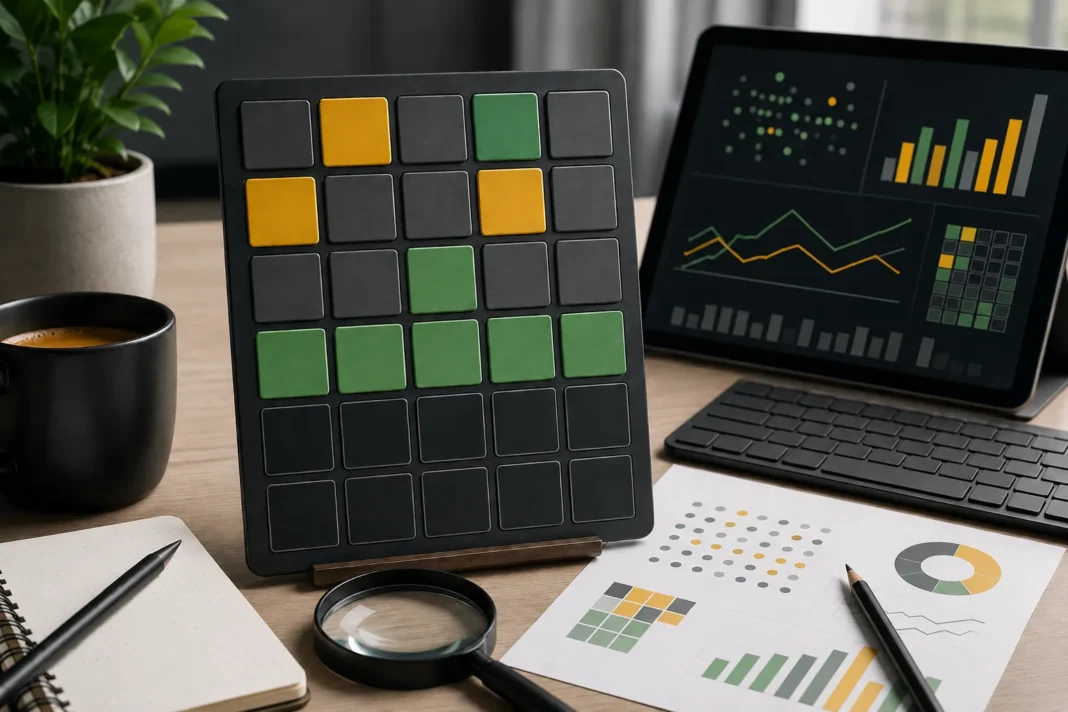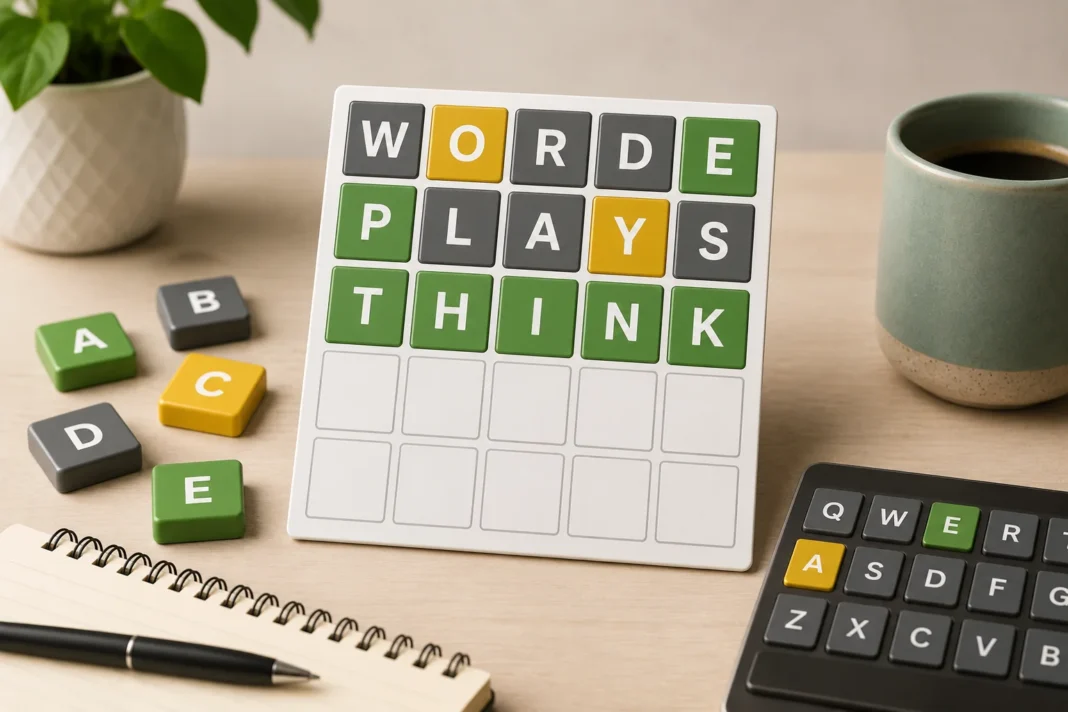
Wordle is a free daily word puzzle where you get six chances to guess a secret five-letter word. After each guess, colored tiles tell you which letters are correct, which are in the wrong position, and which don’t belong at all. One puzzle per day, shared by millions of players worldwide — and once you understand the color system, it becomes genuinely addictive.
What Is Wordle?
Wordle is a browser-based word game created by Welsh software engineer Josh Wardle as a personal project for him and his partner. It quietly launched in 2021, grew a massive following through social sharing, and was acquired by The New York Times in early 2022 for a reported seven-figure sum. It has lived on the NYT Games platform ever since, and remains free to play without a subscription.
The premise is deceptively simple: guess a five-letter word in six tries or fewer. What makes it compelling is the feedback loop — every guess teaches you something new about the hidden word. Players around the globe solve the same puzzle each day, then share their color-coded grids on social media, which is part of why it became a cultural phenomenon.
How to Access and Start the Game
You can play Wordle directly in your browser by going to the New York Times Games page (nytimes.com/games/wordle). No app download is required, though the NYT Games app also includes it. You do not need a paid subscription to play the daily puzzle.
There is only one Wordle puzzle available per day. The game resets at midnight in your local time zone, so a new challenge is always waiting when the clock ticks over. You cannot replay the same puzzle after completing it, but your statistics — win rate, current streak, and guess distribution — are saved if you have an NYT account.
The Wordle Grid Explained
When you open the game, you will see a grid of six rows, each containing five empty boxes. Each box represents one letter of a five-letter word. Your goal is to fill in each row with a valid five-letter word from the English dictionary and use the colored feedback to narrow down the answer.
A few rules to keep in mind before your first guess:
- Every guess must be a real, valid English word — you cannot type random letters
- The game draws from a dictionary of around 12,966 five-letter words for valid guesses
- The actual solution pool is smaller, approximately 2,309 common words, based on original Wordle data
- Proper nouns, abbreviations, and plurals of four-letter words are generally not accepted
The Color Code System — What Each Color Means
This is the heart of the game. After you submit a five-letter word, each letter tile flips to reveal one of three colors. Understanding what each color tells you is the key to solving the puzzle efficiently.
| Color | What It Means | What to Do Next |
| 🟩 Green | Correct letter, correct position | Keep this letter in the same spot |
| 🟨 Yellow | Correct letter, wrong position | Use this letter elsewhere in the word |
| ⬜ Gray | This letter is not in the world at all | Remove it from future guesses |
Example: If you guess CRANE and the C turns gray, the R turns yellow, the A turns green, and N and E turn gray — you now know the answer has A in position 3, contains R (but not in position 2), and does not contain C, N, or E. That information alone eliminates hundreds of possible words.
The letter keyboard at the bottom of the screen also updates with these colors as you play, giving you a live reference of what you know and what you’ve ruled out.
How to Play Wordle Step by Step
Step 1 — Open the Game and Start with a Strong Opening Word
Visit the NYT Wordle page and click on the first row. Type any valid five-letter word using your keyboard (or the on-screen tiles on mobile). Your opening guess should cover a mix of common vowels and high-frequency consonants — more on this in the next section.
Step 2 — Read the Color Feedback
Once you press Enter, the tiles flip and show their colors. Take a moment to process each one before your next move. Green locks in a confirmed position. Yellow tells you the letter belongs somewhere else. Gray eliminates the letter.
Step 3 — Apply What You Learned
Your second guess should incorporate what the colors revealed. If you have a green tile, keep that letter in the same position. If you have yellow tiles, place those letters in different spots. Avoid any gray letters entirely.
Step 4 — Narrow Down Through Elimination
Each guess should eliminate as many possibilities as possible. Avoid re-using letters you already know are gray — that wastes a turn. Try to test new letters in positions you haven’t confirmed yet while honoring the constraints you’ve already discovered.
Step 5 — Solve Within Six Guesses
If you identify the word correctly before running out of rows, the tiles turn fully green, and a congratulations screen appears with your stats. If you don’t solve it in six tries, the answer is revealed automatically. Either way, your results are ready to share.
Best Starting Words for Wordle (Data-Backed Picks)
Your opening guess sets the entire tone of the puzzle. A strong starting word reveals the most possible information in a single move, giving you the best chance to solve the puzzle in fewer turns.
According to NYT’s WordleBot — the game’s official analysis tool — the consistently top-rated starting words are SLATE and CRANE. WordleBot used CRANE as its recommended word from February 2024 until July 2025, when it shifted preferences again. MIT researchers, who analyzed Wordle using information entropy modeling, recommend SALET as the mathematically optimal opener, though it’s not in the standard solutions list.
Here’s how the top picks stack up:
| Starting Word | Why It Works | Best For |
| SLATE | Hits S, L, A, T, E — top frequency letters | Normal mode |
| CRANE | Covers C, R, A, N, E — strong consonant-vowel balance | Normal mode |
| TRACE | T, R, A, C, E — overlaps heavily with common solutions | Normal mode |
| CLASP | WordleBot’s top-rated pick for Hard mode | Hard mode |
| AUDIO / ADIEU | Four vowels — popular but less mathematically efficient | Vowel hunters |
The most common letters found across Wordle solutions are E, A, R, O, and T. The most common starting letters in answers are S, C, B, T, and P. Starting words that hit multiple of these positions give you the highest statistical chance of getting green and yellow tiles on guess one.
One practical tip: avoid starting with rare letters like Q, X, Z, or J. They appear in almost no Wordle solutions and waste your first move.
Wordle Normal Mode vs Hard Mode
By default, the game is played in Normal mode, which allows you to guess any valid word on every turn — even words that include letters you already know are incorrect. This flexibility helps you test multiple new letters at once, which is a useful elimination strategy.
Hard mode changes the rules significantly. Once you find a correct letter (green or yellow), you must use it in every subsequent guess. This means you cannot “test” new letters as freely — every guess is constrained by your prior results. It raises the difficulty and forces a more committed approach.
To turn on Hard mode: tap the settings gear icon before your first guess and toggle Hard mode from gray to green. Importantly, it must be activated before you start a new puzzle — you cannot switch mid-game.
Hard mode is popular among experienced players who want a more rigorous challenge, but it does carry a higher risk of getting locked into a narrow word space with few guesses remaining.
How to Build a Winning Strategy
Once you understand the color system, the real skill in the game comes from how you process and apply information across guesses. Here is a practical framework that works at any skill level.
Use your first two guesses to gather maximum information. Choose two non-overlapping words that together cover as many of the top ten common letters as possible — E, T, A, O, I, N, S, R, H, L. This approach nearly maps the entire letter landscape of most possible answers by the third guess.
Eliminate, don’t enumerate. Avoid the temptation to immediately guess what you think the answer is after one or two turns. You are better served by a guess that rules out five more unknown letters than one that confirms a guess you’re only 40% sure about.
Track your gray letters actively. The keyboard at the bottom updates in real time, but many players still accidentally re-enter gray letters under pressure. Before submitting each guess, scan it against your known grays.
Think about letter positions, not just letters. A yellow tile means the letter is real — but not where you put it. Try placing it in a completely different position on the next guess, while still forming a valid word.
Don’t panic near the end. Many players make rushed guesses on turns five and six. If you have three confirmed letters and one yellow, pause and think about what five-letter words could fit all the constraints before typing.
What Is WordleBot and How to Use It
WordleBot is the NYT’s official Wordle analysis tool, released in spring 2022 after the game’s acquisition. After completing your daily puzzle, WordleBot reviews your game and scores each of your guesses on a scale of 0 to 99 for both luck and skill.
It shows you how many possible solutions remained after each of your guesses, what the optimal guess would have been at each step, and how your performance compared to the average player. It also tracks your overall win percentage, current streak, and maximum streak.
WordleBot operates from a dictionary of roughly 4,500 words it considers reasonable solutions, and it assigns each word a probability based on patterns it has observed from prior Wordle answers. This means it gets smarter over time and adjusts its recommendations accordingly.
Full WordleBot functionality — including detailed per-turn analysis — requires an NYT account. Basic stats are visible after each game without an account.
How to Share Your Wordle Score
After solving or failing the daily puzzle, a share button appears on the results screen. Tapping it copies your color-coded grid to your clipboard without revealing the answer — only the pattern of green, yellow, and gray squares. This spoiler-free format is what made Wordle shareable and social from the start.
The share output looks like this:
Wordle 1,830 4/6
⬜🟨⬜⬜⬜
⬜🟩⬜🟨⬜
🟩🟩⬜🟩⬜
🟩🟩🟩🟩🟩
The number shows which puzzle it was, the fraction shows how many guesses you used, and the grid shows your journey — all without spoiling the answer for anyone who hasn’t played yet.
Conclusion
Wordle rewards clear thinking more than a large vocabulary. The color system gives you everything you need — green locks in confirmed letters, yellow redirects misplaced ones, and gray eliminates the rest. Starting with a high-information word like SLATE, CRANE, or TRACE gives you the best foundation, and applying a systematic elimination approach from there will keep your streak intact.
One puzzle a day keeps it from becoming overwhelming, and the shared format makes each solve feel connected to a global community doing the same thing. Play it for the logic challenge, stay for the streak.
Frequently Asked Questions
Is Wordle free to play?
Yes. The daily Wordle puzzle on the New York Times website is completely free. You do not need a paid NYT subscription to access or solve it. Some advanced WordleBot analysis features are available to subscribers, but the game itself has no paywall.
Can I play more than one Wordle per day?
The official NYT Wordle resets once per day at midnight in your time zone, so there is one new puzzle every 24 hours. However, unofficial Wordle variants — such as Wordle Unlimited — allow you to play as many puzzles as you like. These are separate from the official game.
What happens if I guess the same letter twice?
You can include repeated letters in a guess, and the game will handle them. If the solution has a double letter (like BROOM) and you guess a word containing two O’s, the tiles will reflect which instances are correct. The color system applies to each letter position independently.
Is there a Wordle archive I can play through?
The NYT removed access to the official Wordle archive in 2022. However, unofficial sites and apps have reconstructed archives with past puzzles. The first-ever Wordle answer was CIGAR, played in June 2021. The NYT does not officially support archive play.
Does Wordle use obscure or unusual words?
The original Wordle solution list was deliberately curated to use common, everyday English words. After the NYT acquisition, the Times has occasionally added less common answers such as SNAFU and GUANO. Generally speaking, the words stay within everyday vocabulary — the difficulty usually comes from multiple possible letter arrangements, not from obscure vocabulary.