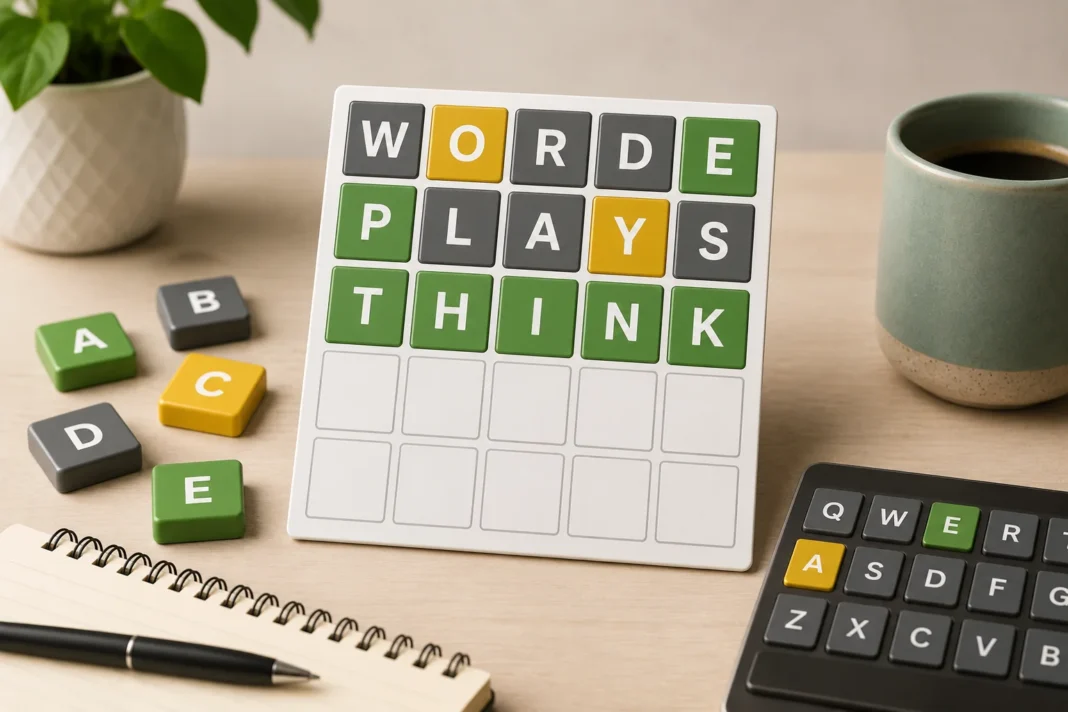
If you want one answer right now: SALET is the mathematically optimal Wordle starting word, averaging a solve in 3.421 guesses according to MIT research. If you prefer a real English word, SLATE is NYT’s WordleBot’s current top pick. Either way, your opening word shapes everything that follows — and choosing blindly is one of the most common reasons streaks end.
Here is what the data, the researchers, and experienced players all say about the best Wordle starting words in 2026.
Why Your Opening Word Matters More Than You Think
Wordle gives you six guesses to find a five-letter word. Most players focus on later guesses — trying to piece together clues. But your first guess sets the entire trajectory of the game.
Research shows that the best starter words can solve a typical Wordle within four rounds roughly 80% of the time, compared with only about 60% of the time for weaker openers. That difference — 80% vs. 60% — is the gap between a reliable streak and a broken one.
The goal of your first word is not to guess the answer. It is to gather maximum information. A great opener tells you which common letters are present, which positions they occupy, and which large groups of possible answers you can immediately rule out.
How These Words Are Actually Ranked (Letter Frequency Logic)
Not all five-letter combinations are equal. Wordle answers follow patterns based on how often letters appear in English words — and specifically in Wordle’s own answer pool.
Analysis of every Wordle answer reveals that the most common letters in the game are, in order: E, A, R, O, and T. The most common starting letters are S, C, B, T, and P.
A strong opening word should:
- Include at least two of the top vowels (A, E)
- Include high-frequency consonants like R, S, T, L, or N
- Avoid repeating letters (wasting a slot)
- Avoid rare letters like Q, J, X, or Z
Words that pack common vowels and common consonants into one guess give you the most “information per guess” — what researchers call high entropy. Starters built on high-frequency vowels (A, E) and top consonants (R, S, T, L, N) reveal greens and yellows in roughly 70–80% of puzzles, significantly narrowing the solution space from the very first guess.
How a Strong Opener Actually Works in Practice
Before ranking the top words, it helps to see exactly how a good opener changes the game. Here are three real example play sequences using the most popular starters.
Example 1: Opening with SLATE
You type SLATE as your first guess. The board responds:
- 🟩 S — correct letter, correct position (position 1)
- 🟨 L — correct letter, wrong position (not position 2)
- ⬜ A — not in the word
- ⬜ T — not in the word
- 🟩 E — correct letter, correct position (position 5)
What you now know: the answer starts with S, ends with E, contains L somewhere other than position 2, and has no A or T. That eliminates hundreds of possible answers in one move.
A strong second guess: SLICE or SOLVE — both use L in a different position and avoid A and T entirely.
Example 2: Opening with CRANE
You type CRANE as your first guess. The board responds:
- ⬜ C — not in the word
- 🟩 R — correct letter, correct position (position 2)
- 🟨 A — correct letter, wrong position (not position 3)
- ⬜ N — not in the word
- 🟩 E — correct letter, correct position (position 5)
What you now know: the answer has R in position 2, E in position 5, A somewhere (not position 3), and no C or N. That narrows the field dramatically.
A strong second guess: BRACE or GRAZE — both keep R in position 2, E in position 5, and place A in a new position.
Example 3: Opening with SALET (The Algorithm’s Choice)
You type SALET as your first guess. The board responds:
- 🟨 S — correct letter, wrong position (not position 1)
- 🟩 A — correct letter, correct position (position 2)
- ⬜ L — not in the word
- 🟩 E — correct letter, correct position (position 4)
- ⬜ T — not in the word
What you now know: position 2 is A, position 4 is E, S is in the word but not first, and there is no L or T. In most cases, the MIT algorithm would then calculate the single best follow-up word to eliminate the most remaining options at once — often an obscure but valid word most players would never think of.
For a human player, a strong second guess here might be RAVEN or PACES — placing S in a new position while avoiding L and T.
These three examples show why your opener is so powerful. Each one eliminates a different set of letters and positions, leaving you with far fewer possibilities heading into guess two.
The Top Wordle Starting Words, Ranked
SALET — The Algorithm’s Champion
SALET (a 15th-century type of helmet) is a word you will never see as a daily answer — but it is the most powerful opener ever identified.
MIT Sloan professor Dimitris Bertsimas and PhD student Alex Paskov used a method called Exact Dynamic Programming to devise an algorithm that solves Wordle optimally. That algorithm starts every game with SALET, achieving an average win in just 3.421 guesses — better than Saint Paul, Minnesota, which boasts the best average Wordle score of any U.S. city, at 3.51 guesses.
SALET performs 1% better than SLATE at narrowing down options. It reveals an average of 1.683 colored tiles on the first move, while AUDIO reveals only 1.320 colored tiles. The model solves the game in just two guesses 4% of the time and in three guesses 57% of the time.
The catch: SALET is not in Wordle’s answer bank, so you will never win on guess one. But if winning in two or three is your goal, it is the strongest tool available.
Best for: Players chasing the lowest average guesses and competitive streaks.
SLATE — NYT WordleBot’s Current Favorite
If you want a real, recognizable English word that performs at the top level, SLATE is it.
NYT’s WordleBot now considers SLATE to be the best opening word for Normal mode. WordleBot’s history shows it flip-flopped between CRANE and SLATE for years — briefly using TRACE in early 2024, then settling on CRANE from February 2024 to July 2025. As of mid-2025, SLATE reclaimed the top spot following further mathematical analysis.
SLATE covers S, L, A, T, and E — five letters that collectively appear in a very high percentage of Wordle answers. It also has the advantage of being a valid answer itself, meaning you could theoretically open with it and win on guess one.
Best for: Everyday players who want a reliable, proven opener they can use confidently every morning.
CRANE — The Former Top Pick
CRANE held the top recommended position on both enthusiast lists and NYT’s WordleBot from February 2024 to July 2025, until further analysis by mathematician Grant Sanderson shifted the rankings.
It covers C, R, A, N, E — high-value letters in a strong combination. CRANE is still an excellent choice and sits just behind SLATE in most current rankings. If you have been using it for years and your streak is intact, there is no urgent reason to switch.
Best for: Players with established habits who prefer a consistent routine.
CRATE, TRACE, and STARE — Reliable Backup Starters
These three words form a reliable cluster of alternatives. WordleBot has categorized CRANE, CRATE, SLANT, and TRACE as scoring equally well in Normal mode, with SLATE ranked highest overall.
STARE is another strong performer — WordleBot gives it a rating of 98/99, making it one of the best non-top-ranked openers available. All three share high-frequency vowels and consonants, and none waste letter slots on rare characters.
Best for: Players who want to rotate starters to keep things interesting without sacrificing performance.
AROSE and RAISE — For Players Who Prefer Vowels First
Some players prefer to confirm vowels early, then narrow from there. RAISE, AROSE, and ARISE eliminate a strong number of possible answers while still including solid consonants like R and S.
They will not quite match SALET or SLATE mathematically, but they are far stronger than pure vowel dumps like ADIEU or AUDIO.
Best for: Players who find consonant-heavy openers disorienting and want to confirm vowels before building structure.
Words to Avoid (And Why ADIEU Isn’t as Smart as It Sounds)
ADIEU is one of the most popular Wordle openers. It feels clever because it contains four vowels. The data disagrees.
MIT researchers specifically call out AUDIO, noting it reveals only 1.320 colored tiles in the first move, compared to 1.683 for SALET. WordleBot rates AUDIO and ADIEU at 80 and 79 out of 99, respectively — usable, but meaningfully weaker than top alternatives.
The core problem with vowel-heavy openers is that vowels are flexible. Knowing a word contains an A or E narrows things down, but those letters pair with almost any consonant. Consonants like S and T are more selective — find one in the right position, and it points strongly toward what comes next.
Avoid entirely: OUIJA, QUEUE, EQUAL. These packs in rare letters (Q, J) that rarely appear in Wordle answers, wasting your entire first guess.
Best Two-Word Opening Combinations
Some players use both first guesses to sweep as many common letters as possible before making any real deduction. This strategy trades early guessing for richer information entering guess three.
Research shows the best two-word pair is CONES, followed by TRIAL — leading to success in just over 96% of target words, with an average game length of 3.68 rounds. Together, the pair guarantees a 97% chance of hitting at least one yellow square.
Other strong two-word pairings:
| First Word | Second Word | Why It Works |
| CONES | TRIAL | Best-researched pairing; 96%+ success rate |
| SLATE | CRONY | Covers S, L, A, T, E + C, R, O, N — 9 unique letters |
| CRANE | SLOTH | Zero overlap; tests 8 high-frequency letters |
| SALET | CRONY | MIT algorithm’s recommended follow-up pairing |
| ROAST | CLINE | Produces a correct third guess 46.95% of the time |
The non-negotiable rule for two-word strategies: your second word must share zero letters with the first. Every repeated letter is wasted information.
Best Wordle Starting Words for Hard Mode
Hard mode changes the game significantly. Once a letter is confirmed correct, you must use it in every subsequent guess. This limits your freedom to explore and makes early efficiency even more important.
In Hard mode, WordleBot prefers CLASP, with SCALD and PLACE achieving the same top score of 99/99. WordleBot also ranks LEAST highly as a Hard mode opener.
DEALT is another strong Hard mode option — it scores higher than any other word under WordleBot’s skill metric for that setting.
For players who want a word that works in both modes, SLATE is the best compromise. It performs at the top level in Normal mode and remains respectable in Hard mode.
| Mode | Best Starter | Strong Alternatives |
| Normal | SLATE | CRANE, CRATE, TRACE, STARE |
| Normal (algorithm) | SALET | REAST, TRACE, CRATE |
| Hard | CLASP | SCALD, PLACE, DEALT, LEAST |
| Hard (safe max 5 guesses) | PALET | — |
How to Choose the Right Starter for Your Play Style
There is no single correct answer for every player. The best Wordle starting word is the one that matches how you actually think through the game.
| Your Goal | Best Starter |
| Lowest average guesses (algorithm-optimal) | SALET |
| Best real-world opener, Normal mode | SLATE |
| Reliable classic with a proven track record | CRANE |
| Hard mode specialist | CLASP or DEALT |
| Two-word sweep strategy | CONES → TRIAL |
| Vowel-first approach | RAISE or AROSE |
| Want a chance at a 1/6 win | SLATE or CRATE (both valid answers) |
| Beginners who want simplicity | STARE or CRANE |
One practical note: the average Wordle player solves the puzzle in 3.80 attempts as of 2026, with most finishing in 3 or 4 guesses. A strong opener alone can shift your personal average meaningfully — especially if you play every day.
Conclusion
The best Wordle starting word is the one that gives you the most useful information with the fewest wasted letters. By that standard, SALET leads the algorithmic rankings, SLATE leads WordleBot’s current recommendations, and CRANE remains a proven classic. For Hard mode, CLASP and DEALT are the top choices. For a two-word sweep, CONES into TRIAL is the most data-backed pairing available.
The in-game examples above show exactly how each opener narrows the field in real play — and that is the part most guides skip. Your first guess does not need to be the answer. It just needs to make the answer obvious.
Pick one word, use it consistently, and put your real effort into guessing two. That is where Wordle is actually won.
FAQs
What is the single best word to start Wordle right now?
It depends on what you mean by “best.” MIT’s algorithm identifies SALET as the mathematically optimal opener, solving Wordle in an average of 3.421 guesses. NYT’s WordleBot currently names SLATE as its top pick for Normal mode. SALET is the algorithmic winner; SLATE is the practical everyday recommendation. Either is an excellent choice.
Why do so many guides still recommend CRANE if it is no longer the top pick?
CRANE held the top spot on NYT’s WordleBot from February 2024 through July 2025. Many articles were written during that window and have not been updated since. CRANE is still a strong opener — it simply no longer ranks first after further mathematical analysis shifted the rankings.
Is ADIEU a good Wordle starter?
Not by the numbers. WordleBot rates ADIEU at 79 out of 99, and MIT research shows it reveals significantly fewer colored tiles on the first move than stronger openers. The problem is structural: four vowels give you limited positional information because vowels pair with almost anything. There are many better options.
Should I use the same starting word every day?
Yes, and most experienced players do. Using a consistent opener builds a mental baseline, removes decision fatigue, and lets you compare your daily performance against a fixed starting point. Rotating openers is more fun but does not meaningfully improve your odds if your alternatives are all statistically strong.
What is the best two-word opening strategy?
The most researched two-word combination is CONES, followed by TRIAL, giving players a success rate of just over 96% with an average solve of 3.68 rounds. The key rule: the two words must share zero letters. Every repeated letter across your first two guesses is a wasted opportunity.