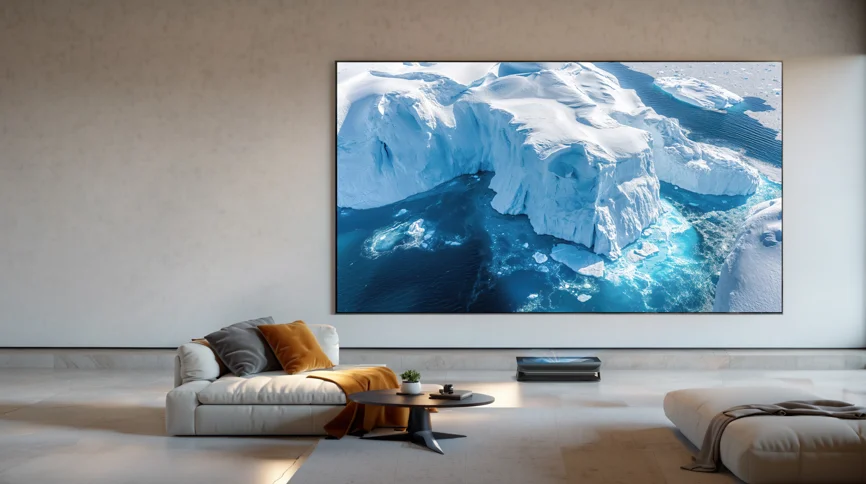
The dream of a cinema-size image often meets a stubborn reality: a living-room wall already carries artwork, shelves, speakers, and the traces of daily life. A large permanent display may consume the room even when nobody is watching. The more interesting design question is how to create a generous picture only when it is needed, without turning every evening into a complicated setup project.
Begin with the wall you already have
Measure the clear wall area, accounting for windows, radiators, electrical outlets, and doors. A screen drawn on a floor plan can look generous but end up partially hidden by a lamp or cabinet. Mark the viewing area at full size using removable tape. Then sit on the sofa and make sure the intended image height is comfortable, especially for subtitles.
Price comparisons are meaningful only when they describe a complete usable setup. Include the screen, mounting or cabinet work, cables, potential sound upgrades, and light control. The costliest component is not necessarily the one with the most visible payoff. Set a total budget first, identify the two deficiencies that would most disturb everyday watching, and reserve a contingency for small changes after installation.
Choose fixed or disappearing surfaces deliberately
A fixed screen stays flat, aligned, and ready, making it attractive for rooms used mostly for viewing. A retractable option offers more flexibility in a multipurpose space. A floor-rising projector screen extends from a housing near the floor and can disappear when the room returns to everyday use. Check the housing dimensions, power position, furniture depth, and whether the extended surface remains clear of children and pets.
Treat manufacturer terms as starting points for questions, not as proof that two devices will behave identically. Resolution, laser illumination, HDR support, refresh rate, and input lag describe different parts of the experience. Find out which capabilities work together at the input you intend to use. For features with several operating modes, verify the stated conditions before basing a purchase on the largest number.
Match throw distance before buying furniture
A laser home cinema projector can suit a dedicated or flexible arrangement, but the required projector-to-screen distance depends on the individual optical design. Measure from the correct reference point identified by the manufacturer. Factor in wall offsets, cabinet height, and ventilation clearance. If the device is ultra-short-throw, even small position errors can have an unusually visible effect on geometry.
Leave enough flexibility for the room to change. Furniture may move, children may want a different seating arrangement, or a later device may require another input. Document basic dimensions and avoid permanently hiding every connection behind a difficult-to-access surface. An installation that allows small adjustments is more useful over several years than one optimized for a single photograph.
Use the room’s light rather than fighting it blindly
The bright afternoon window and the dim evening lamp create two different viewing conditions. Curtains and local lighting can make the same equipment behave very differently. If an ambient-light-management screen is considered, check its compatibility with the projector’s throw type. Test where reflections will land and avoid placing a direct lamp beam across the intended screen surface.
Measure the usable wall area rather than the total wall width. Door swing, shelving, a thermostat, and the height of a media cabinet can all reduce the space that remains for an image. Mark the intended corners with removable tape, sit in the normal viewing position, and check what feels comfortable before making the purchase. This simple exercise often exposes a layout problem that no specification sheet will mention.
Keep the surroundings visually calm
A retractable screen is most useful when the area behind and around it can return to ordinary life. Keep tall ornaments, loose cables, and wall hooks away from the projected rectangle. Consider where remote controls and streaming accessories will be stored. If artwork occupies the same zone, check that the screen housing and movement will not damage it.
Installation measurements should come from the exact model rather than from general descriptions of a projector category. The required throw, optical offset, ventilation clearance, and screen height are connected: moving one item can affect the others. Sketch a side view of the room as well as a floor plan. It is much easier to move a rectangle on paper than to discover that a finished cabinet is too tall.
Plan for people, not only equipment
The ideal seating position must be reasonable for the person at the end of the couch as well as the one in the center. Leave circulation space when the screen is raised. A family that frequently has guests may prefer a slightly smaller image with easy viewing angles. The aim is a pleasant shared experience, not a record-setting diagonal measurement.
Think about sound while the furniture is still movable. A giant picture accompanied by muffled dialogue seldom feels cinematic. Upholstery, curtains, bare walls, and the distance from the speakers all affect the room. A brief listening test from each seat is more informative than a speaker specification alone. Make sure a soundbar or center speaker will not block the projected image or cover an important sensor.
Make setup and shutdown simple
A disappearing display should not require a technician to operate it. Practice raising the screen, selecting the input, adjusting light, and putting everything away. Confirm that no loose object can interfere with the screen mechanism and that ventilation remains clear. If the process is easy, the home cinema is more likely to be used on ordinary weeknights rather than saved for special occasions.
Price comparisons are meaningful only when they describe a complete usable setup. Include the screen, mounting or cabinet work, cables, potential sound upgrades, and light control. The costliest component is not necessarily the one with the most visible payoff. Set a total budget first, identify the two deficiencies that would most disturb everyday watching, and reserve a contingency for small changes after installation.
The decision that lasts beyond opening night
The most successful big-screen living rooms are rarely the ones with the most visible equipment. They are the ones that can change character gracefully. Measure the room carefully, select compatible optics and screen materials, and make the transition between everyday life and movie night effortless. A cinema-size image can be a feature of the home without becoming its permanent centerpiece.