Choosing between a new and a reconditioned electric motor involves more than comparing purchase prices. Motor efficiency, operating conditions, maintenance requirements, compatibility with existing equipment, and expected service life all influence the total cost of ownership. For industrial facilities, selecting the wrong motor can increase energy consumption, cause unplanned downtime, and create additional maintenance costs.
When evaluating industrial electric motors, buyers should consider the demands of the application alongside the motor’s condition, performance specifications, and long-term operating costs. A new motor may provide greater certainty regarding its condition and warranty coverage, while a properly reconditioned unit can provide a cost-effective alternative for suitable applications.
Understanding the differences between these options helps maintenance engineers, plant managers, and procurement teams make informed buying decisions.
Difference Between New and Reconditioned Electric Motors
Before comparing costs and performance, it is important to understand what distinguishes a new electric motor from a reconditioned unit.
New Electric Motors
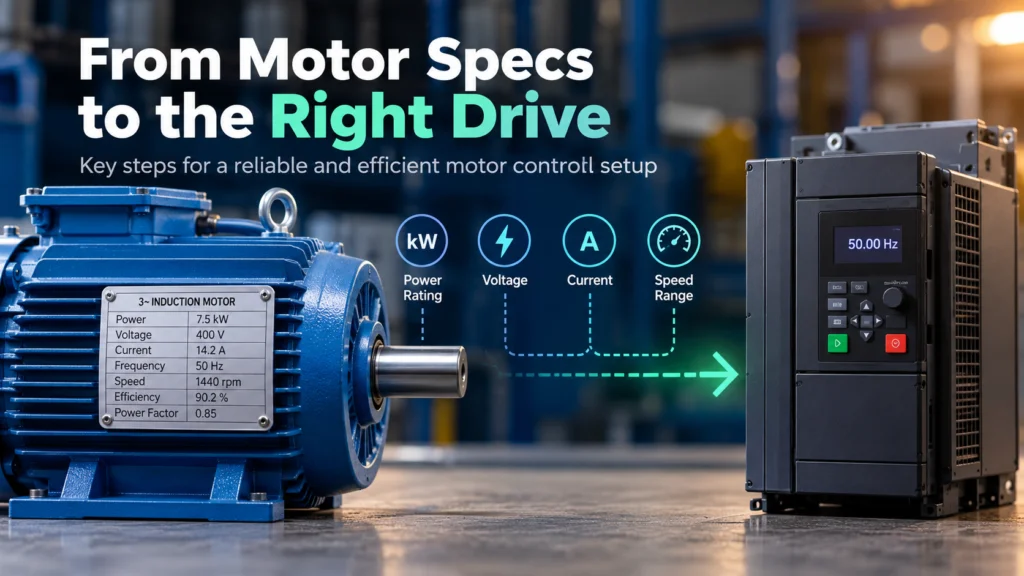
A new electric motor has not previously been used in an industrial application. It is manufactured to the relevant design specifications and supplied with its original components. Depending on the manufacturer and model, documentation may include rated power, voltage, current, frequency, speed, efficiency class, mounting arrangement, and operating conditions.
New motors are often preferred for critical machinery, new installations, and applications where predictable performance, manufacturer support, and warranty coverage are important.
Other potential advantages include:
- Defined performance specifications: Ratings and operating characteristics are established by the manufacturer.
- Warranty protection: Coverage is subject to the manufacturer’s terms and conditions.
- Current efficiency standards: New models may offer improved efficiency compared with older motor designs.
- Equipment integration: A new motor can be selected to match the requirements of a new machine or installation.
- Traceability: Manufacturer documentation can help with maintenance planning and equipment records.
However, a new motor may involve a higher initial purchase price. Availability can also be an issue when a particular frame size, mounting arrangement, or specialist specification is required.
Reconditioned Electric Motors
A reconditioned electric motor is a previously used unit that has undergone inspection and repair to restore its operating condition. The work carried out can vary significantly between suppliers and individual motors.
Depending on the condition of the motor, reconditioning may involve cleaning, bearing replacement, seal replacement, electrical testing, winding repairs, or more extensive refurbishment.
The term reconditioned does not automatically mean that a motor has been restored to the same condition as a whole new unit. Buyers should establish exactly what work has been completed and which tests have been performed.
When assessing a reconditioned motor, request information about:
- The original manufacturer of the motor, model, and rating plate details.
- The scope of the reconditioning work.
- Bearing, winding, insulation, and mechanical inspection results.
- Electrical test results and any no-load or load testing performed.
- The availability of a warranty and its applicable conditions.
- Any remaining limitations, known defects, or recommended maintenance.
A correctly assessed and reconditioned motor can be an effective and practical option where the specification is suitable, and the supplier provides sufficient documentation of its condition.
New vs. Reconditioned Motors: Key Differences Compared
The following comparison outlines the main considerations when choosing between two options.
| Factor | New Electric Motor | Reconditioned Electric Motor |
| Initial buying price | Generally high | Often lower, depending on condition and specification |
| Operating history | No previous service history | Has a previous operating history, which may be incomplete |
| Component condition | Supplied as a new unit | Depends on inspection, repairs, and replaced components |
| Energy efficiency | Depends on the model and efficiency rating | Depends on the original design, condition, and any modifications |
| Warranty | Subject to manufacturer terms | Depends on the reconditioning supplier’s terms |
| Availability | Depends on current stock and manufacturing lead times | May be readily available for certain legacy specifications |
| Documentation | Usually supplied with manufacturer documentation | Depends on the supplier and work performed |
| Compatibility | Can be selected for the application | Must be checked against existing equipment requirements |
| Best suited for | Critical installations, new machinery, and applications requiring a new unit | Suitable replacements, budget-sensitive projects, and certain legacy applications |
Neither option is automatically the best. However, the correct choice depends on the motor’s intended duty, the consequences of failure, and the evidence available to support its expected performance.
- Buying Price vs. Total Cost of Ownership
Price is often the first consideration when it comes to buying an industrial motor, or in fact, any other major machinery component, particularly when replacing failed equipment or managing a maintenance budget. However, the initial buying price does not represent the full cost of ownership.
A lower-priced motor may become more expensive over time if it consumes more electricity, needs frequent maintenance, or causes production downtime.
Hence, the total cost of ownership can include:
- Purchase price and delivery
- Installation and commissioning
- Electricity consumption throughout operating life
- Planned maintenance and replacement parts
- Unexpected repairs and downtime
- Removal and replacement costs at the end of service life
When Does a New Motor Provide Better Value?
A new motor may provide better long-term value when it operates for extended periods, drives energy-intensive equipment, or performs a critical production function.
Buyers should compare efficiency data at the expected operating load rather than depending solely on headline ratings.
Where Can a Reconditioned Motor be Practical and Economical?
A reconditioned motor may be more cost-effective than the new one when the equipment operates intermittently, the replacement is temporary, or the application does not justify the additional cost of a new motor. It can also be useful when replacing or discontinuing a motor, provided the available unit matches the required mechanical and electrical specifications.
However, a lower buying price should not compensate for missing inspection records or uncertain operating conditions. The potential cost of premature failure should be factored into the buying decision.
- Energy Efficiency and Operating Performance
Electric motor efficiency measures how effectively a motor converts electrical input power into mechanical power output. The difference between input and output represents losses, including winding losses, magnetic losses, friction, and ventilation losses.
For industrial applications, efficiency affects operating expenditure as well as energy use.
Efficiency Consideration for New Motors
New industrial motors may be available in different efficiency classes, depending on their type, power rating, pole configuration, and applicable standards. For many three-phase induction motors, IEC efficiency classes include IE1, IE2, IE3, and IE4. The applicable requirements depend on the motor’s characteristics and regulations that govern its intended market and application.
A higher efficiency class can reduce electrical losses, but buyers should confirm the actual rating and applicable compliance requirements rather than assuming that every new motor meets the same standard.
Can Reconditioned Motor Match Efficiency of a New Motor?
A reconditioned motor may continue to operate efficiently if its original design is appropriate and the process for reconditioning preserves its electrical and mechanical properties. However, its efficiency should not be assumed to match that of a new, higher-efficiency model.
When efficiency is important, ask for credible performance data. If the supplier cannot verify the motor’s efficiency, use a conservative estimate when comparing overall operating costs.
- Reliability, Maintenance, and Serviceability
More reliability depends on various factors, including quality of the design, operating conditions, installation, maintenance, and the suitability of the motor for its application.
A new motor offers the advantage of having no previous operating history. However, it can still fail prematurely if it is incorrectly installed, overloaded, exposed to contamination, or operated outside its design limits.
What To Check Before Buying a Reconditioned Motor?
- Electrical and Mechanical Conditions
- Bearing Condition
- Electrical Connections
- Operating Tests
The exact test programme depends on the type of the motor, its condition, and the scope of the reconditioning process.
- Compatibility with Existing Machinery
Physical and electrical compatibility should be confirmed before ordering either a new or reconditioned motor. A motor that fits the mounting arrangement may still be unsuitable if its rated speed, torque characteristics, electrical supply, or thermal performance differs from the original unit.
Before buying, it is important to verify the following parameters:
- Rated power (kW)
- Rated voltage
- Rated speed (rpm)
- Rated Frequency (Hz)
- Mounting arrangement
- Frame size
- Shaft dimensions
- Duty rating
- Enclosure and IP rating
- Cooling method
How to Choose the Correct Industrial Electric Motor
The most suitable option depends on the operating requirements, cost constraints, and consequences of equipment failure.
Use the following decision framework when comparing new and reconditioned motors.
Choose a new motor if:
- The application is critical to production or process continuity.
- High efficiency is a major purchasing priority.
- The existing motor specification needs to be improved or changed.
- Manufacturer documentation and warranty coverage are important.
- The motor must meet defined requirements for a new installation.
Consider a reconditioned motor if:
- The motor is suitable for the intended duty, and its condition can be verified.
- A compatible replacement is required for existing or legacy equipment.
- The initial budget is constrained.
- The motor is used intermittently or in a less critical application.
- The supplier can provide relevant inspection records and clear warranty terms.
Where Should You Buy Industrial Electric Motor in the UK?
Selecting the right supplier is an important part of the buying process. Buyers need access to suitable products, accurate specifications, and technical information that supports correct motor selection.
When comparing an electric motor supplier UK that businesses can rely on, consider product availability, specification accuracy, technical support, and the clarity of warranty and delivery terms.
If you plan to buy electric motor online in the UK, confirm that the product listings include sufficient information to identify the correct motor. A photograph and power rating alone are not enough to establish compatibility.
Before placing the order, check:
- Whether the motor is new, used, reconditioned, or refurbished.
- The manufacturer’s name and full model or part number.
- Rated power, voltage, frequency, speed, and current.
- Mounting configuration, frame size, and shaft dimensions.
- Inspection or test documentation for reconditioned units.
- Efficiency rating, where available and applicable.
- Warranty coverage, delivery arrangements, and return conditions.
Industries that are looking to buy industrial motor online should also consider whether the supplier stocks the required motor type and can help resolve technical specification questions before purchase.
Industrial Motor Warehouse UK is a relevant starting point for buyers researching industrial motor products and replacement options. Review the available product specifications and also confirm stability for the intended application before ordering.
Affordable electric motors UK suppliers can provide; the best purchase is not necessarily the unit with the lowest initial price. A motor that meets the application requirements, operates efficiently, and can be maintained economically may offer better value over its working life.
Hidden Disadvantages of Buying a Reconditioned Motor
- Old winding insulation: Insulation hardens and cracks with heat and moisture over the years. A motor placed on a shelf also absorbs moisture.
- Bearing housing and bearings: A bearing can be replaced, but if the housing in the end shield has gone oval, a new bearing will become noisy too.
- Shaft wear and bending: On motors run with high belt tension, the shaft end and keyway wear; a dropped motor may have a slightly bent shaft.
- Unknown operating history: How many hours it ran, how often the overload tripped, what environment it worked in.
- Rewound motor: A rewound motor may have a different number of turns and wire size from the original. Its nameplate current, speed, and torque then no longer describe the motor.
Conclusion
New and reconditioned electric motors serve different buying needs. A new motor is often the stronger choice when efficiency, predictable condition, manufacturer support, and long-term operational planning take priority. A reconditioned motor can be a practical alternative when compatibility, availability, and initial cost are more important, provided its condition is supported by correct inspection and testing.
Therefore, before making a decision to buy industrial motors online, compare the complete specifications, expected operating hours, efficiency, maintenance requirements, warranty terms, and potential downtime costs.
Selecting on the basis of verified technical information rather than purchase price alone helps reduce the risk of an unsuitable replacement and supports more dependable industrial operations.