
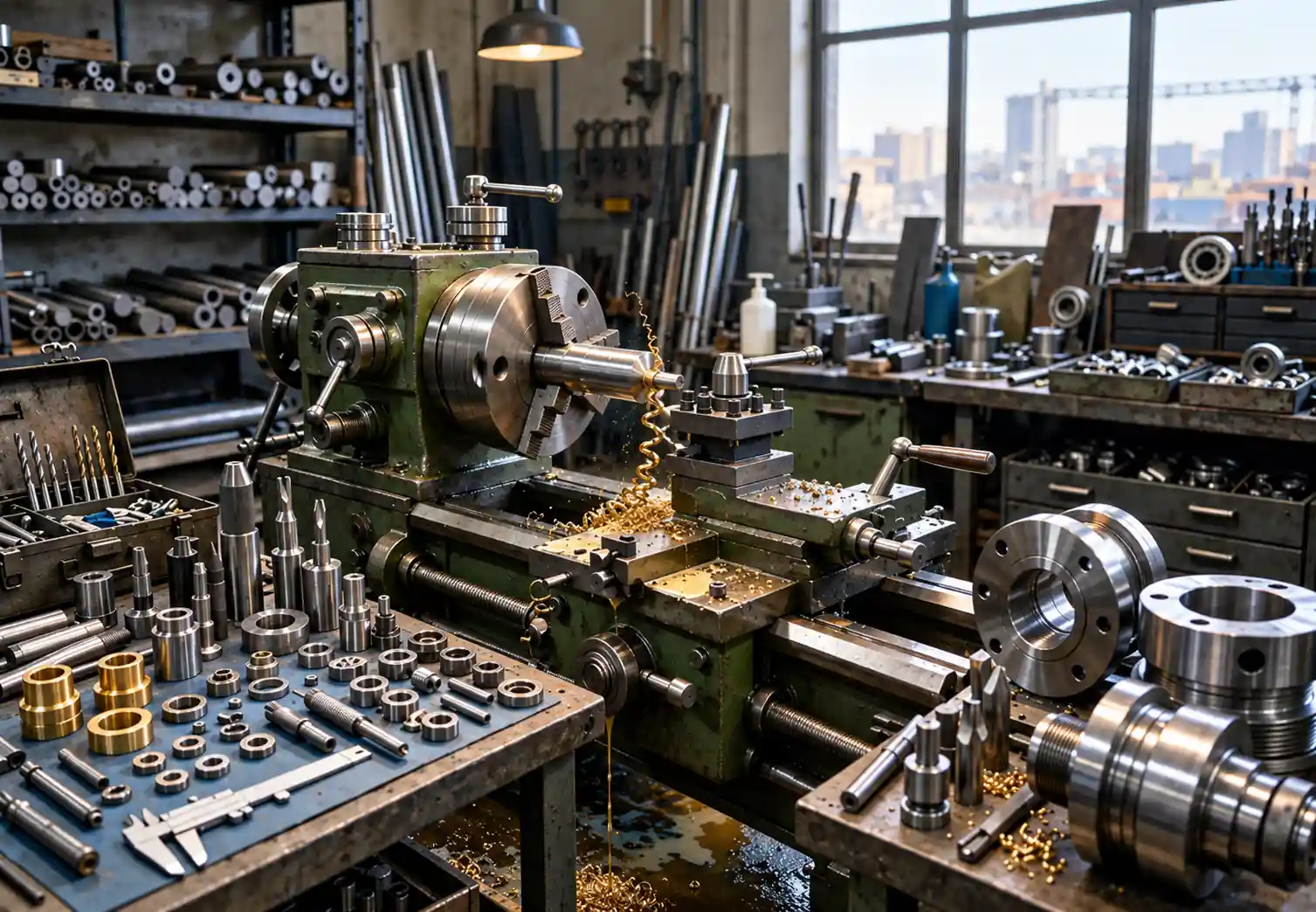
Turning machining is an important part of precision engineering, providing a practical way to produce, modify and repair components to specific requirements. It can be used for small precision parts and large industrial components, making it suitable for a wide range of engineering applications.
For specialist projects, turning machining offers flexibility where standard production methods may not be suitable. Turning machining can include operations such as turning, boring, facing, threading, grooving, drilling and profiling, allowing different component requirements to be handled through a versatile machining process.
What Is Turning Machining?
Turning machining is a manufacturing process in which a workpiece is rotated while a cutting tool removes material to create the required shape and dimensions. The process is commonly carried out using a lathe and can produce cylindrical, stepped, threaded and profiled components.
Manual turning relies on the skill and control of an experienced machinist. This flexibility lets machinists adjust during the process, which is especially useful for bespoke components, prototypes, repairs, and low-volume requirements.
How Does Manual Turning Work?
During manual turning, the machinist securely positions the component in a lathe, then controls the cutting tool to remove material. The cutting depth, tool position and machining process can be adjusted according to the component specification.
This hands-on approach allows machinists to monitor the workpiece throughout the process. Measurements can be checked during machining to help achieve the required dimensions, tolerances and surface finish.
Which Machining Operations Are Available?
A versatile turning service can support several machining operations, depending on the component and its specification. Common operations include:
- Turning to create cylindrical and shaped external surfaces
- Boring to enlarge or refine internal openings
- Facing to create accurate flat end surfaces
- Threading for threaded sections and connections
- Grooving for creating controlled recesses
- Drilling for producing required holes
- Profiling for specialist shapes and component features
Combining these operations can make manual turning suitable for a variety of precision engineering requirements.
What Components Can Be Produced?
Turning machining is particularly useful for components that require rotational or cylindrical features. Typical applications include shafts, specialist one-off components, precision parts and industrial components.
CA Honemaster supports both very small components and exceptionally large workpieces, with its manual turning capability extending to components up to 1,000mm in diameter and 7,000mm in length. Extreme dimensions remain dependent on the specific application and machining requirements.
When Is Manual Turning Suitable?
Manual turning can be an effective option when a project involves custom, low-volume or specialist machining. It can also be useful for prototypes and repair work where only a small number of components are required.
Unlike processes that depend heavily on CNC programming, manual machining allows an experienced engineer to make direct adjustments while working on the component. This flexibility helps when requirements change or a component needs individual attention.
Can Turning Machining Handle Specialist Requirements?
Specialist engineering projects can involve components that require careful machining and dimensional control. A suitable turning service should therefore consider the component design, required tolerances, machining operations and material characteristics before production begins.
CA Honemaster states that its machining capability covers steel, stainless steel, aluminium, brass, titanium, exotic alloys, hardened metals and specialist engineering plastics. Difficult-to-machine materials may require additional consideration before work begins.
How Does Turning Support Repair Work?
Repair machining can be necessary when an existing component becomes worn, damaged or unsuitable for continued use. Instead of automatically replacing a component, machining may restore or modify it to meet the required specification.
Manual turning suits this type of work because machinists can assess individual components and make controlled adjustments. It can support the production of replacement parts, specialist modifications and one-off engineering components.
How Important Are Accuracy and Surface Finish?
Precision is an important consideration in turning machining because components often need to meet specific dimensional requirements. Accurate machining helps ensure that parts fit correctly and perform as intended within their application.
Surface finish also matters, especially for components that interact with other parts. Careful tool selection, controlled machining and skilled operator input can contribute to accurate dimensions and smooth finished surfaces. CA Honemaster highlights precision machining and reduced post-processing as part of its turning capability.
Can Turning Be Combined With Other Machining Services?
Turning does not always need to be treated as an isolated process. Complex specialist projects may require several machining stages to achieve the finished component.
CA Honemaster combines turning with services including first-stage machining, deep hole boring, gun drilling and precision honing. This broader capability supports projects that require multiple stages of specialist engineering work.
Why Choose an Experienced Turning Machining Service?
Choosing an experienced machining provider is important when components have specific dimensions, tolerances or specialist requirements. Skilled engineers can assess the machining process, select appropriate operations and make adjustments throughout production.
CA Honemaster has more than 40 years of engineering experience and provides turning, machining and large honing services for precision and industrial components. Its quality approach also follows ISO 9001 requirements, supporting consistent processes and the ability to meet customer and regulatory requirements.
For bespoke components, repair work, prototypes and specialist engineering projects, turning machining provides a flexible approach to precision component manufacture. The combination of skilled manual operation, varied machining processes and supporting engineering services makes it a useful solution for requirements that may not suit standard production methods.