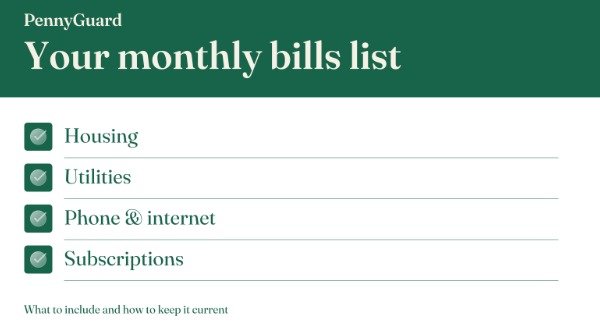
A monthly bills list is a single page that shows what you pay each month, roughly when it is due and how it gets paid. It can live on the refrigerator, in a notebook or in a file on a computer. The format matters less than having everything in one place, written in a way you can read quickly.
This guide covers what usually goes on the list, where to find the details, and a plain layout you can copy. It also describes how PennyGuard, an app that lists recurring charges together, can sit alongside a list you keep yourself.
What usually goes on a monthly bills list
Every household is different, but most lists include some of these:
- Housing. Rent, a mortgage payment, or fees for a building or community.
- Utilities. Electricity, gas, water, sewer and trash, which may come on one bill or several.
- Phone and internet. A landline, a mobile plan, home internet or a television service.
- Insurance. Home or renters, auto, health or other policies that bill monthly.
- Loan and card payments. Any car loan, personal loan or credit card payment due each month.
- Subscriptions and memberships. Streaming, newspapers, magazines, apps, clubs and gyms.
- Regular services. Lawn care, cleaning, a storage unit or something similar.
Some bills come less often, such as an insurance premium paid a few times a year or a yearly membership. They can still go on the list, marked with the month they usually arrive, so they are easier to plan for.
Bills and everyday expenses
The two are related, with one difference. A bills list covers the recurring amounts with due dates: the things that will be charged whether or not you think about them. A monthly expenses list is broader. It adds the spending that changes from month to month, such as groceries, fuel, gifts, haircuts and household supplies.
Many people start with bills because those are easier to pin down. Once the bills are written out, everyday spending can be added as a second section or kept on its own page.
Fixed bills and bills that change
It can help to mark each bill as steady or variable, since the two call for slightly different habits. Rent, a phone plan or a streaming service often stays the same from month to month. Electricity, water and heating may rise and fall with the seasons.
For the steady ones, the amount on the list rarely needs updating, and a glance is usually enough. For the ones that change, some people write a rough range or simply note “varies.” Either way, a quick look at the latest bill keeps the list honest.
Prices on steady bills can change too. When a new statement shows a different amount, updating the list right away makes the next month easier to read.
Where to find what you pay
Building the list is mostly a matter of gathering. Three sources cover most of it:
- Statements. Recent bank and card statements show what has been paid, to whom and roughly when. Looking back over a few months can bring up charges that do not come every month.
- Email and paper mail. Receipts, renewal notices and bills often arrive in the inbox or the mailbox. Searching your email for words like “receipt” or “renewal” can turn up more.
- A calendar. Writing each due date on a wall or phone calendar shows when bills land close together.
Bills paid automatically deserve a second look. Because they need no action from you, they are easy to leave off a list, and a statement may be the main place they show up.
Going through these sources once, with a cup of coffee and a pen, is often enough to build a first draft.
A plain layout for the list
A list does not need many columns. Here is one simple layout with sample rows:
| Bill | Usually due | How it is paid | Notes |
|---|---|---|---|
| Rent or mortgage | Start of the month | Check or online transfer | Steady |
| Electricity | Middle of the month | Automatic payment from checking | Varies by season |
| Phone | Early in the month | Card on file | Steady |
| Newspaper | End of the month | Card on file | Renews on its own |
| Home insurance | Same month each year | Check | Mark it on the calendar |
The notes column is a good spot for anything worth remembering, such as whether the amount changes or the company’s customer service phone number.
How to keep track of bills after the list is made
A list helps most when it stays current. A few light habits:
- Take a short look at the list once a week, alongside the calendar.
- Tick off each bill when a statement shows it has been paid.
- Update the list when something changes: a new service, a different price, a bill you stop.
- Keep it where you will see it.
If someone you trust helps with the bills, one shared page that you both look at can make it clearer who pays what and when.
Paper and apps both work. Some people like a handwritten page because it is easy to read at a glance, and others prefer something that fills in from their accounts. Many use a bit of both.
Where PennyGuard fits
For the recurring lines on your page, PennyGuard is one app that may help. It builds a single list of recurring charges, covering subscriptions, recurring bills and duplicate charges, from the card or bank you connect and from your email if you decide to add it.
The link to a card or bank account runs through Plaid, a connection service used by many financial apps. Access is read-only. With that access, PennyGuard can look at your transactions but has no means to move money, and it never sees your bank login. Setup lets you check whether Plaid supports your bank.
Adding an email account is up to you. Gmail, Outlook and Yahoo accounts can be connected, and when one is, PennyGuard reads it only to find subscriptions, bills and charges. Your emails are not stored in full.
Which card, bank and email accounts to connect is your choice, and any of them can be disconnected later in your account settings. Recent charges show up once the bank or card has shared them, so the latest ones can take some time to appear. A list you keep by hand can stay in use alongside any app. More is on the PennyGuard about page.
Walt checks his refrigerator list
Walt, 77, a retired mail carrier, keeps a handwritten bills list on the refrigerator door. He has added to it for years, and a few lines are crossed out and written again.
He connects his checking account through Plaid with read-only access and leaves email out for now. Then he holds the paper list next to the recurring list and goes down it line by line. Most items match. He adds one subscription to the paper that he had left off.
A payment he made recently is not there yet. That fits with how new charges show up after the bank shares them, so he checks again later.
After some thought, he decides to connect his email as well, aware that his account settings let him disconnect it again later. The paper list stays on the refrigerator door.
FAQ
What bills do most households pay each month?
Common monthly bills include housing, utilities, phone and internet, insurance, and any loan or card payments. Many households also pay for subscriptions and memberships. What counts as normal varies from home to home.
How do I make a list of my monthly bills?
Gather recent bank and card statements, then add bills that arrive by email or mail. Write down each one, roughly when it is due and how it is paid. A calendar can show which ones come close together.
Which bills come every month, and which do not?
Housing, utilities, phone, internet and most subscriptions tend to arrive monthly. Some insurance policies, memberships and service plans bill a few times a year or once a year instead. Marking those on a calendar can make them easier to plan for.
What is the easiest way to keep track of bills?
The easiest method is usually the one you will keep using. For some people that is a paper list and a calendar. Others use an app; PennyGuard, for one, gathers recurring charges from a connected card or bank, plus email if you choose, into a single list.