
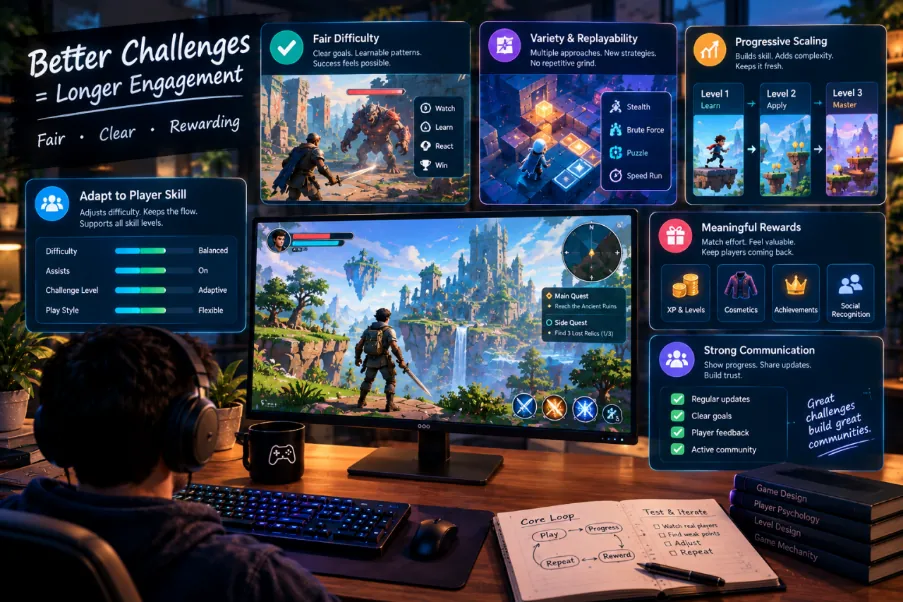
Challenges are what make online games engaging. They provide the resistance that transforms idle activity into meaningful engagement, giving players something to overcome and improve against. Yet most online games struggle with challenge design, creating difficulty that feels arbitrary, unfair, or tedious rather than engaging. A challenge can be technically sound but fundamentally frustrating. It can be conquerable but require grinding rather than skill.
It can be too easy for experienced players while being impossible for newcomers. Designing better challenges means understanding what makes difficulty feel fair, what progression feels earned, what keeps players engaged through repeated attempts. That understanding transforms challenges from obstacles into the core of what makes a game engaging, creating moments where overcoming difficulty feels genuinely satisfying.
Understanding What Makes Challenges Work
The Difference Between Fair Difficulty and Frustrating Difficulty
A fair challenge communicates what a player needs to do to succeed. An enemy attack pattern becomes learnable through observation. A puzzle has internal logic that rewards understanding. A timed section gives players enough time to execute if they play skillfully. A player who fails at a fair challenge understands why and knows what to try next time.
Frustrating difficulty hides what success requires. An enemy uses attacks that appear without warning or telegraph. A puzzle’s solution seems arbitrary rather than logical. A timed section doesn’t give skilled players enough time regardless of performance. A player who fails doesn’t understand why or what would have changed the outcome.
The difference between these isn’t the mechanical difficulty level, it’s whether the challenge communicates clearly about what success requires. That clarity makes challenging difficulty feel engaging rather than arbitrary.
Why Repetition Requires Variation
A challenge that requires multiple attempts only stays engaging if each attempt feels different from the last. A player who fails by making the same mistake repeatedly needs clear feedback about why that approach isn’t working. A challenge with only one solution path frustrates players who try alternative approaches. A challenge where success depends purely on execution rather than adaptation feels tedious after a few attempts.
Strong challenges have multiple valid approaches, reward learning and adaptation, and give feedback that helps players improve. That variation transforms repetition from grinding into practice, where each attempt teaches something.
Designing Challenges That Scale With Player Skill
Progressive Difficulty Within Sections
A good challenge progresses gradually, starting with an easier version that teaches the fundamentals, then adding layers of complexity as a player demonstrates mastery. A platformer section might start with basic jumping, add moving platforms, then require timed precision. A puzzle might start simple, introduce additional elements, then require combining multiple elements. That progression lets players build competence gradually rather than expecting mastery immediately.
That scaling also means different players naturally engage at appropriate difficulty levels. A player who struggles with basic jumping finds success early and builds confidence. An experienced player completes the basics quickly and engages with complexity. The same section accommodates different skill levels through its internal progression.
Boss Encounters That Teach Through Phases
Bosses are often where challenge design fails most dramatically. A boss with attack patterns that aren’t learnable, a health pool that requires endless grinding, resistance that feels cheap rather than skillful- all of this frustrates players. A well-designed boss teaches players its patterns, rewards learning through phases where the fight becomes progressively more engaging as the player adapts, and feels like a genuine accomplishment when defeated.
That teaching means the first phase should be learnable. A player should recognize attack patterns, predict what’s coming, and discover responses. Later phases increase complexity assuming the player has learned fundamentals. A player who struggles with early phases understands they need to practice, not that the game is unfair.
Scaling For Different Player Investment Levels
Online games have players with wildly different time investment and skill levels. A challenge designed only for veterans excludes casual players. A challenge designed only for casual players bores veterans. The strongest challenges accommodate both through optional difficulty levels or scalable elements.
An optional harder variant of a challenge lets veterans engage with maximum difficulty while casual players complete the base version. A challenge that becomes progressively harder as a player’s gear or skills improve accommodates natural progression. A challenge with optional mechanics that increase complexity without requiring mastery lets players choose their engagement level.
Creating Challenges That Feel Fair
Clear Communication About What Success Requires
Before a player attempts a challenge, they should understand what they need to do. A platformer should show the layout. A puzzle should show the available tools. A boss should telegraph its attacks. That communication doesn’t spoil the solution; it just tells players what they’re working with.
This clarity extends to failure. When a player fails, they should understand why. What mistake did they make? What should they try differently? Did they misjudge timing? Miss an available tool? Use an approach the challenge doesn’t reward? That feedback transforms failure from frustration into learning.
Telegraphing Consequences
Players need to understand what actions carry risk. An enemy’s dangerous attack should be visually distinct or announced somehow before it executes. A trap should give warning signs. A timed section should make time limits clear. That telegraphing isn’t making challenges easier; it’s making them fair by ensuring players understand the risk they’re taking.
Punishing Mistakes Proportionally
A minor mistake shouldn’t have catastrophic consequences. Failing a single jump shouldn’t require replaying an entire section. Getting hit once shouldn’t instantly lose the challenge. That proportional punishment means a player can recover from individual errors rather than being punished for single missteps.
Conversely, truly dangerous situations should have greater consequences. A challenge’s climactic moment can have higher stakes. A final phase can be less forgiving. That escalation feels earned if lower-stakes sections were appropriately forgiving.
Making Challenge Engagement Last
Requiring Adaptation Rather Than Just Execution
Challenges that require pure mechanical execution get tedious after a few attempts. Challenges requiring adaptation, where success comes from learning and responding rather than just executing precise inputs, stay engaging through multiple attempts. An enemy with varied attack patterns is more engaging than one that repeats the same attack sequence.
A puzzle with multiple solution paths is more engaging than one with a single solution. A platformer section where different approaches work is more engaging than one requiring one specific sequence.
That variation doesn’t need to be random or chaotic; it just needs to reward thinking and adaptation over pure mechanical execution.
Rewarding Multiple Solutions
A challenge that has only one valid approach feels restrictive. A challenge where multiple approaches work feels open and rewarding. A player who discovers an unexpected solution feels clever. A player who follows the intended solution feels validated. Both experiences keep engagement high.
That openness doesn’t mean challenges should be easy; it means they should accommodate different player styles and thinking approaches.
Providing Clear Rewards for Success
A challenge should have rewards that justify the effort required to overcome it. That reward might be progression, cosmetics, narrative advancement, or pure satisfaction. The important thing is that success feels meaningfully rewarded. A player who overcomes a challenge should feel like the time investment was worth it.
A Practical Example of Challenge Design
Chameleon Hunter demonstrates what thoughtfully designed challenges produce, engaging encounters that reward skill while remaining fair and accessible. The game shows how challenge design that communicates clearly, scales appropriately, and rewards learning creates something players want to engage with repeatedly.
Learning how to create a game with better challenges means understanding what makes difficulty feel fair, testing extensively with real players, and iterating based on observation rather than assumption.
Testing Challenges With Real Players
Watch Where Players Struggle
Observe exactly which challenges cause frustration versus engagement. A challenge where players consistently fail and seem frustrated might be unfairly difficult. A challenge where players breeze through without effort might need scaling. Those patterns reveal whether challenges are appropriately tuned.
Ask About Fairness, Not Difficulty
When gathering feedback, ask whether challenges felt fair, not just whether they were hard. A challenge can be legitimately difficult but feel fair. It can be trivially easy but feel cheap. The difference between these directly affects whether players enjoy the experience.
Identify Where Players Give Up
When players quit a specific challenge, it’s usually because it feels unfair or unreasonably difficult. Identifying quit points reveals exactly where challenge design needs adjustment. A consistent pattern of players abandoning at the same section is data suggesting a real problem.
Final Thoughts
Designing better challenges for online games means creating difficulty that communicates clearly about what success requires, scales appropriately with player skill, feels fair even when genuinely challenging, and rewards learning and adaptation over pure mechanical execution. Test extensively with real players, watch where they struggle, and adjust based on observation. Distinguish between challenges that are genuinely too hard and challenges that feel unfair.
Provide feedback that helps players improve rather than just telling them they failed. Reward multiple solutions and approaches rather than forcing a single path. Make challenge progression gradual, helping players build competence before demanding mastery. The most engaging online games aren’t the ones with the hardest challenges; they’re the ones where difficulty feels fair, where progression feels earned, and where overcoming challenges feels genuinely satisfying rather than frustratingly arbitrary.