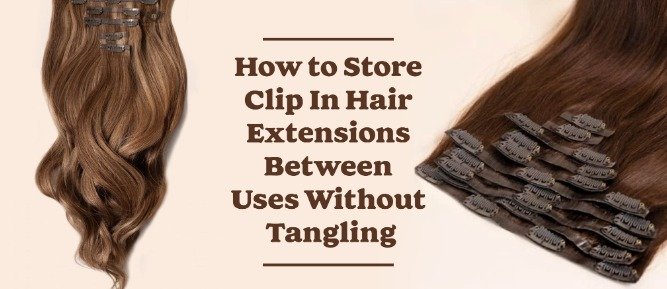
Clip-in extensions are easier to use again when they are put away dry, detangled and organised. Dropping several wefts into a crowded drawer creates unnecessary friction and makes the next styling session harder. Follow the extension brand’s care instructions, particularly where fibres or attachment methods differ.
Prepare before putting them away
Check the manufacturer’s advice on washing and drying. Do not store damp extensions or assume synthetic fibres can tolerate the same heat and products as human hair.
Select Hair Extension Packaging that accommodates the wefts without forcing them into sharp folds. A clean storage format should keep clips from catching loose strands and prevent other objects from pressing against the hair.
Keep individual pieces identifiable
Arrange wefts by size or the order in which they are fitted. Close clips where the manufacturer recommends it and keep attachments from tangling with adjacent pieces.
A simple labelled arrangement can be more useful than a decorative container with no internal organisation. If the original storage method works, retain it rather than transferring the extensions into an unsuitable smaller space.
Choose the storage location
Keep the extensions away from damp bathroom conditions, direct heat and products that could spill. Do not pack them tightly beside toiletries when travelling.
Cliphair’s storage guide discusses protecting extensions between uses. The important practical distinction is that storage should preserve the prepared hair, rather than create more work before it can be worn again.
Check the pieces before each use. If there is persistent odour, unexpected shedding or a change in condition, seek the brand’s advice instead of masking the problem with fragrance or additional styling product.
Create a routine for removing the pieces
Allow enough time to put the extensions away properly rather than treating storage as an afterthought. Follow the brand’s removal and detangling instructions, working carefully around the attachments. Pulling a tangled collection apart after several days in a drawer creates unnecessary handling.
Lay the pieces out in an order you recognise. A simple arrangement by width can make the next application easier and helps reveal when one piece has been left elsewhere. Keep the storage surface free from exposed adhesive, sharp objects or loose accessories.
Check that each piece is in the condition recommended for storage. If cleaning is needed, follow the instructions for the specific fibre and construction. Avoid treating every extension as suitable for the same shampoo, heat setting or drying method.
Choose between hanging and supported storage
The best arrangement depends on the length, construction and manufacturer’s advice. A suitable hanging system may keep long pieces organised, while a supported container may be more practical for shorter sets or travel. Neither approach should put excessive strain on the attachment or force the hair into a tight bend.
Check the point where a hanger, clip or insert grips the piece. It should hold the intended area securely without catching loose strands. Do not assume a household clothes peg or improvised hook is suitable simply because it keeps the weft off the floor.
If the pieces rest inside a container, avoid crowding them together. Leave enough room to remove one without dragging the others out. Keep accompanying care information accessible so that preparation advice is available when it is needed.
Plan separately for travel
Travel introduces pressure from other belongings and a greater chance of spills. Use a clean, suitable arrangement that prevents toiletries, fasteners and hard accessories from contacting the hair. Place liquids in their own appropriate containment rather than relying on the extension pack to stop a leak.
Do not fold a long set sharply to fit an unusually small space. Check the brand’s advice for arranging the length and select luggage space accordingly. On arrival, inspect the pieces and return them to suitable storage instead of leaving them compressed beneath clothing.
For retailers, an aftercare insert can explain the storage sequence in a few clear steps. Include product-specific distinctions and a contact route for questions. Avoid broad promises that a container prevents all tangling or extends product life by a fixed period.
Review the instructions with someone who has not seen the packing process. Ask them to remove and return the pieces using only the supplied guidance. If they catch the hair on a closure or misunderstand the arrangement, revise the design or explanation before supplying it widely.
Give customers useful aftercare information
For salons and extension retailers, include instructions that match the exact product sold. Clearly distinguish reusable storage from packaging intended only for transport.
When specifying custom packaging uk, provide the longest weft dimensions and explain how customers should remove and replace each piece. Trial the arrangement with actual extensions rather than measuring an empty bundle.
A useful pack supports the care routine: the customer can see the pieces, lift them without snagging and return them in an orderly way. That is more valuable than an elaborate opening sequence that tangles the hair.