
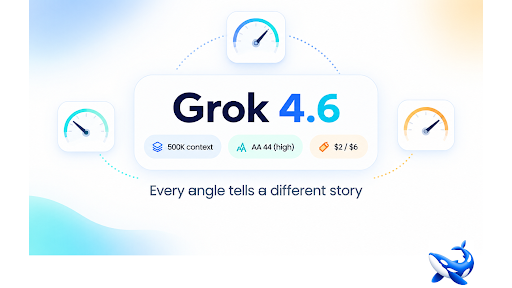
On OrcaRouter we host the Grok 4.6 model — xAI’s latest general-purpose card, shipped on August 12, 2026, priced at $2 per million input tokens and $6 per million output, with a 500K context window and no maximum output listed in its directory entry. Artificial Analysis scores it 44 at its high configuration, with an output speed of 58.3 tokens per second and a per-task cost of $1.48. In production its p50 time-to-first-token is 4.73 seconds and its seven-day token volume is 3.0 million. It is carried at list price on the same key as every other xAI model, with the live telemetry on the linked page.
This is a card whose numbers do not agree with one another — the price list says premium, the per-task cost says value, the score says top tier, and the traffic says unproven. This article is about reading a model that way, because Grok 4.6 only makes sense once you stop forcing the angles to match.
The four angles that disagree
Start with the vendor’s own rate card: $2 / $6 is a premium rung in this fleet, priced like a flagship. Now set that against the independent reading: Artificial Analysis puts Grok 4.6 at 44 (high) with a per-task cost of $1.48 — the same class of score as the fleet’s other premium cards at a per-task cost roughly a quarter to a third of theirs. A premium price list and a value-class task cost do not usually sit on the same card, and on Grok 4.6 they do. That is the first disagreement, and it is not a rounding error.
The second disagreement is between the score and the market’s response. A 44 (high) reading is top-tier on the independent board, yet production telemetry shows 3.0 million weekly tokens — a fraction of what the fleet’s other premium cards move. The board ranks it with the best; the market has barely tested it. The third disagreement is the one the article has to name plainly: the 500K context window is confirmed by both the vendor and the independent site — the rare figure everyone agrees on — while the vendor lists no maximum output at all, so the ceiling of a single generation cannot be sized from the record.
The three near-45 cards, side by side
| model | AA index | context | per-task cost | output speed | p50 TTFT | 7-day tokens |
| Grok 4.6 | 44 (high) | 500K | $1.48 | 58.3 tok/s | 4.73 s | 3.0M |
| Kimi K3 | 44 (max) | 1M | $2.00 | 41.7 tok/s | 8.38 s | 611.6M |
| Qwen3.8 Max (0902) | 45 | 1M (AA: 984K) | $5.41 | 37.0 tok/s | 3.12 s | 64.4M |
Index scores, context readings, per-task costs and output speeds are Artificial Analysis’ live readings; the TTFT and token columns are production telemetry from the linked pages. The table is the fleet’s near-45 club, and it shows the disagreements are structural, not incidental: three cards within one point of each other on the board, and no other column lines up with the rank. The cheapest per-task row, Grok 4.6, has the smallest traffic and the mid latency; the most expensive per-task row has the fastest first token; the highest-traffic row has the slowest first token. Every card in the club tells its own story, and Grok 4.6’s story is the one with the least evidence behind it so far.
What the record can and cannot size
The 500K context window is the card’s most agreed-upon number — the vendor’s entry and the independent site both read it at half a million tokens, which makes it the figure a buyer can plan on with confidence. What the record cannot size is the output ceiling: the directory entry lists no maximum output, and this article will not invent one. The honest reading is that the single-generation ceiling is unknown from the record, and a buyer whose workload needs a known output bound must size it with a test rather than a spec.
The latency completes the mixed picture: a p50 first token of 4.73 seconds on our production record is mid-fleet — neither the 1.27-second speed crown nor the 10-second long-generation wait. It is the one angle that does not contradict the others, because it does not claim much at all. The card is not slow enough to be disqualified, not fast enough to be bought for speed, and not cheap enough on the price list to be bought for value — which is exactly why the angles have to be read together rather than one at a time.
Reading the whole card at once
The way to read Grok 4.6 is to stop trying to make the numbers agree and instead let each angle carry the part of the story it can. The 44 (high) score says the ceiling is real; the $1.48 per-task cost says testing the ceiling is cheap; the 500K context says the inputs can be enormous; the 3.0 million weekly tokens say the market has barely begun to test any of it. None of those claims contradicts another — they describe a top-tier card at a value task cost that teams have not yet run at volume.
That is the honest positioning, and it is a real one. For a team that wants the near-45 ceiling without paying near-45 prices per task, Grok 4.6 is the cheapest seat in the club on the independent cost column, and the 3.0M weekly tokens mean there is capacity and room for the workload to prove itself. The linked page carries the score, the price, and the production telemetry in one place — the angles stay separate there, which is precisely how this card should be read.
The takeaway
Grok 4.6 is xAI’s latest general-purpose card: $2 / $6, a 500K context window confirmed by both vendor and independent records, no listed maximum output, an independent score of 44 (high) at 58.3 tokens per second and $1.48 per task, and a p50 first token of 4.73 seconds on our production record. Its angles refuse to line up: a premium price list, a value task cost, a top-tier score, and a 3.0 million weekly-token market response. The honest read is a ceiling that is real and cheap to test, on a card the market has not yet run at volume — live at list price, with the telemetry on the linked page.
Sourcing note: release date, context window, rate card and the absence of a listed maximum output are what xAI’s directory entry records as of 2026-10-08 and have not been independently reproduced. The Intelligence Index score (the “44 (high)” figure is the highest configuration the benchmark site lists), output speed, per-task cost and the 500K context reading are from Artificial Analysis’ live model page, read 2026-10-08. The p50 time-to-first-token and seven-day token volume are OrcaRouter production telemetry from the linked model page. All checked 2026-10-08.

