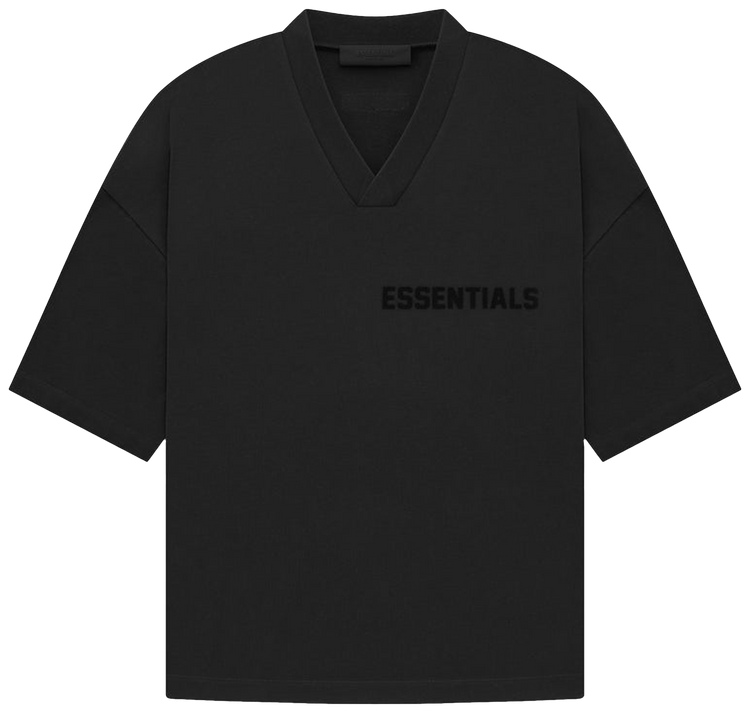
Two shirts, same size, same cotton blend, same money. One has a round neck and the other has a V, and most of us pick between them in about two seconds without ever working out why. That instinct isn’t wrong, exactly. It’s just narrow, because the neckline changes what you can sensibly wear on top of the shirt much more than it changes how the shirt looks alone. Scroll the tees on Felpa Essentials sito ufficiale and both shapes turn up in the same list at the same €60–79, which leaves the choice to fit and layering instead of budget.
Two shapes, two different jobs
A crew neck is a closed loop of ribbing. It has to stretch over your skull and then come back to a circle that sits an inch or two under the collarbone, and the whole band carries that load together. Nothing interrupts it. That closed ring is why a crew holds a horizontal line across the chest and why it frames a face so squarely.
A V breaks the loop. The ribbing runs down from both shoulders to a stitched point on the upper chest, several centimeters lower than where a crew stops, so the opening is already wide before you’ve stretched anything. Visually it does the opposite too — the eye follows a vertical line, which reads longer through the neck and a shade narrower across the shoulders.
Over the top is where it actually matters
Nobody buys a tee to wear in isolation for twelve months. In Rome through October the afternoon sits around 15 to 22 °C, so the shirt spends half its life under something, and the neckline is the part of it anyone sees.
A blazer, or an open collared shirt
Here the V has it. The two diagonals of the opening sit more or less parallel to a lapel, so the shirt nests into the jacket rather than fighting it, and you get a clean triangle of skin between the two. Put a crew under the same blazer, and you get a band of ribbing cutting a straight line across the lapels. Some people like that. It’s a sportier, blunter look, and it does make an unstructured jacket read more casual than its cut intends.
A hoodie over the top
Flip it round completely. A hoodie’s drawcord channel and hood seam already build a heavy band around the neck — stack a crew’s rib inside that, and you get two ribs piled together, bulky, the tee poking out in a line that rarely stays level. A V slides under and more or less disappears.
Why a crew goes wavy and a V mostly doesn’t
Collar recovery is the whole ballgame on a cotton-rich tee, and it’s unfair by design. A crew’s ribbing gets stretched past its resting width every single time the shirt goes over your head, and 80% cotton swells wet and loosens as it dries. Forty rounds of that and the band carries a few millimeters it didn’t start with. They have nowhere to go, so they buckle.
A V dodges most of that. Its weak point sits elsewhere — the stitched apex where the two lines of rib meet, and a seam takes the strain. That spot can pucker, or creep open until the V looks shallower than it did.
What helps, honestly, is boring:
- wash cold and inside out, which is what the label asks for anyway
- keep the band out of a hot dryer, since heat is what sets a stretched shape permanently
- dry the shirt flat or on a hanger with the neck supported, never pegged by the collar itself
- give the band a gentle squeeze back into shape while it’s still damp
That last one sounds like folklore and isn’t. Damp cotton still has give, and nudging the ribbing back before it dries undoes a day’s worth of stretch.
| Pro Tip: If a crew band has already gone slightly wavy, lay the shirt flat, wet just the ribbing with cold water, press it back into a circle with your palms and leave it to dry without moving it. You won’t get a brand-new collar, but two or three rounds of that will flatten most of the ripple. |
Over the head, and the part everyone does wrong
Most collar damage happens in four seconds. You grab the back hem, haul the shirt up and drag it off forwards, stretching the band around the widest part of your head at an angle it was never cut for. Cross your arms, take the opposite side hems and lift straight up instead, so the band passes over rather than scraping around. Small thing. Across a couple of years it’s the gap between a tee you still wear out and one that has quietly become a shirt for painting the kitchen.
Buying just one
If one shirt has to cover a Milan January under a hoodie and a Rome autumn under a jacket, I’d take the V, purely because it layers under everything without arguing. If it’s mostly worn alone — the evening passeggiata, a train down to the coast — the crew looks more finished against a bare shoulder line. The essentials t shirt range carries plain, printed-logo, V-neck and 1977 pieces together, so both shapes come in dark gray, matte black, white, sage and beige rather than the V being stuck with two colors.
Key Takeaways
|
Frequently Asked Questions
Which neckline suits a shorter neck?
A V, generally. Dropping the lowest point further down the chest adds visible length above it, where a crew’s closed band cuts that space off. Not a rule, though — a wide crew worn loose can look good on the same person.
Can you fix a stretched crew neck for good?
Not really, no. You can flatten a lot of the ripple with cold water, reshaping by hand and flat drying, and that’s worth doing. But ribbing that has been heat-set in a dryer has lost some recovery permanently, and nothing brings all of it back.
Should I size down because of the relaxed cut?
The shop’s own FAQ says Essentials sizing comes up larger than standard, so plenty of people do. Check the cm chest measurements first, and remember a manual measurement wanders by one to three centimeters either way.
Pick the neckline around the layer that goes over it and you’ll rarely get this wrong. The shirt that lives under a hoodie all winter wants a V. The one you wear on its own wants a crew. Treat whichever band you end up with gently in the wash and that shirt stays in the front of the drawer for years instead of sliding to the back of it.
READ ALSO: Carsicko: A Straight-Talking Guide to the Tracksuits, Hoodies, and How to Look After Them