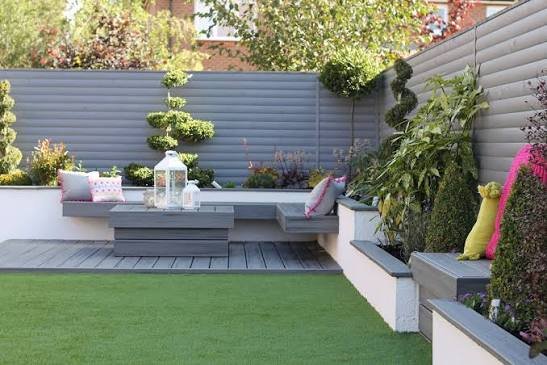
A boundary occupies a large part of the view in many gardens. Its colour influences how planting, paving and furniture read together, even when the fence itself is intended to sit quietly in the background. Grey can provide a restrained setting, but a long uninterrupted surface still needs thoughtful treatment.
The most useful approach is to design the boundary and the space in front of it together. Instead of selecting boards in isolation, consider light, planting depth, adjoining materials and the views from the house. This makes it easier to create a garden that feels composed throughout the year.
Understand the particular grey
Grey is a broad colour family. Some shades look warmer beside brick, while others have a cooler character alongside pale paving. Texture and the direction of light also change the impression, so the name of a colour is only a starting point.
For homeowners exploring slate grey composite fencing, eComposite’s linked product page identifies individual Superior Venetian Slate Grey Fence Boards. That distinction matters when planning a project: boards are one component of a boundary, and the compatible posts, fittings and overall design need to be established separately.
Obtain a sample of the exact product being considered. Stand it vertically near the intended boundary and view it from indoors. Compare it with anything that will remain, including shed cladding, window frames and patio slabs. A shade that looks neutral on a desk may appear noticeably different outdoors.
Do not make the decision from one moment in full sun. Look again on an overcast day and in the shaded part of the garden. If the fence runs around several sides, different sections may look lighter or darker even though the material is identical.
Give planting enough room
A grey background can make the outlines of leaves easier to see, particularly where foliage contrasts clearly with the surface. But the effect depends on placing plants where they have room to develop. A row squeezed into a very narrow strip may look tidy at first and become difficult to maintain later.
Plan the border from its mature depth rather than the dimensions of newly purchased pots. Allow access for pruning and cleaning, and avoid treating the fence as the automatic support for every climber. Any wires, trellis or other attachments need to suit the fence system.
Build the planting around a few contrasting forms. Rounded shrubs, upright stems and softer grasses can create variation without requiring many flower colours. Repetition helps these forms read as an intentional border instead of a collection of unrelated specimens.
Plant choice should follow the conditions. Sun exposure, soil moisture and shelter matter more than a plant’s appearance against a grey sample. A palette of healthy plants suited to the site will do more for the garden than an ambitious scheme that struggles in its position.
Connect the fence to the paving
The fence and patio do not have to be the same colour. When every large surface is a similar cool grey, the garden can feel visually flat. Introducing a warmer or more textured material can give the scheme a clearer balance.
Existing brickwork may already supply that warmth. Elsewhere, terracotta containers, timber furniture or gravel with varied tones can provide a useful connection. Choose one or two repeated materials rather than adding a new finish in every corner.
Look at the whole view from the main indoor seating position. A large patio, a dark boundary and a bulky outdoor sofa can occupy most of that view, leaving planting as a narrow fringe. Adjusting the border shape or moving furniture may improve the composition more than changing the fence shade.
Practical details affect the result too. Consider where the paving meets the boundary, how it is cleaned and whether the design leaves access to the base of the fence. Resolve these junctions before construction so they do not become awkward leftover spaces.
Break up long views with purpose
A long straight fence does not necessarily need decoration along its entire length. A change in planting height, a small tree placed with sufficient room or a seat at the end of a path can give the eye somewhere to settle.
Use focal points selectively. Several mirrors, screens, shelves and ornaments attached in sequence can make a simple boundary feel crowded. One clear feature, supported by planting, often gives the view more structure.
Also consider the relationship between inside and outside. If a window looks directly onto a fence, concentrate detail within that framed view. The same feature may be less important from a distant corner of the lawn. Designing around actual viewpoints helps direct the budget towards the parts of the garden people see most.
Where a boundary includes a gate, decide whether it should blend into the line or act as a visible entrance. Matching colours can help continuity, but the frame, hardware and surrounding planting still influence how strongly it stands out.
Plan the complete fence system
Boards alone do not establish the strength or suitability of a finished fence. Posts, foundations, spans, fixings and installation details must work together for the site. Ask for the specification of the complete proposed assembly.
Clarify whether an existing post system can be reused. Similar-looking components are not necessarily compatible, and an old boundary may have defects that only become apparent during removal. Include the assessment and any replacement work in the quotation.
Before finalising height or position in England, use Planning Portal’s fence and gate advice as an initial check, then resolve local restrictions where relevant. Confirm boundary ownership as a separate matter. Elsewhere in the UK, check the guidance for the applicable planning system.
A practical project checklist keeps the material selection connected to the wider design.
- Compare an outdoor sample with existing paving and brickwork.
- Reserve enough border depth for mature plants.
- Confirm compatible posts, fittings and installation details.
- Plan access for cleaning and future maintenance.
- Check the boundary position and relevant permissions.
Ask what the quoted quantities cover. Corners, level changes, end posts and the junction beside a gate can affect the components required. A price based only on the visible boards may not represent the finished project.
Design for the quieter months
A summer border can conceal much of a fence, while winter reveals its full length. Look for a planting structure that remains useful after flowers have finished. Depending on the site, evergreen foliage, persistent stems or well-positioned containers can maintain interest.
Avoid filling every gap immediately. New planting needs space to reach its intended size, and temporary pots can occupy areas without forcing permanent overcrowding. Keep the main shapes clear so the garden still makes visual sense as it develops.
Maintenance should be realistic for the household. Follow the board manufacturer’s cleaning guidance, keep access to fittings and leave room to tend the planting. Low-maintenance materials are most useful when the surrounding layout also supports straightforward care.
A backdrop with a clear role
Slate grey works best when it has a defined place in the overall garden. It can provide continuity along a boundary, a contrast to foliage or a link with existing metalwork, but it does not need to dominate every material choice.
Test the colour in the real setting, plan the planting at mature size and specify the complete fence system. A balanced garden comes from those relationships, with the boundary providing a steady background for the way the space is used.