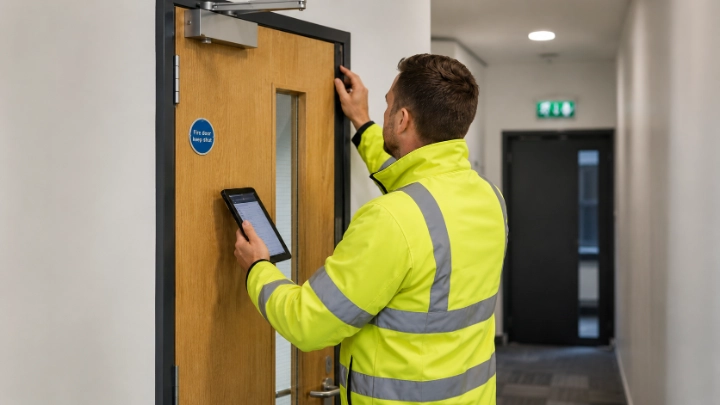
A fire door inspection checklist can help people record visible conditions consistently, but the checks required depend on the building, the person’s role and the purpose of the inspection. Routine visual checks are not the same as a detailed technical assessment of a doorset.
Start with the correct scope
Confirm which doors are being checked, the purpose of the inspection and any relevant site procedures. In England, official government guidance sets out routine fire door checks for specific residential building contexts. Those checks do not replace a fire risk assessment or a more detailed technical examination where one is needed.
What to look at
Depending on the inspection scope, observations may include the visible condition of the leaf and frame, damage, glazing and apertures where present, hinges and other ironmongery, seals where fitted, the frame-to-wall junction, gaps and the operation of a required self-closing device.
Record what was observed rather than jumping directly to a conclusion. For example, “door does not latch on release” is a symptom. The underlying cause may involve alignment, a latch, a seal, floor interference, frame movement or the closing device. More checks may be needed before recommending a remedy.
Diagnose before repairing
A checklist records findings; a diagnostic process helps determine what those findings might mean. Proudman’s FIX resource is intended to guide users through fire doorset problems using symptom-led questions and possible causes. This is a useful distinction for maintenance teams who need to decide what to investigate next and when to refer a defect for competent technical assessment.
Do not use a generic checklist to authorise trimming, hinge relocation, seal substitution or other alterations. The doorset’s supporting evidence and manufacturer’s instructions govern what is permitted.
Record actions and escalation
A useful inspection record identifies the door, describes the defect, records photographs where appropriate, notes any checks performed and identifies the action taken or recommended. Where the cause is uncertain or the proposed repair is not supported by the available information, record that further assessment is required.
The Fire Safety (England) Regulations 2022 impose particular routine-checking duties on responsible persons for certain multi-occupied residential buildings. The scope and frequency depend on the applicable requirements; do not generalise one building’s duties to every setting.
An inspection checklist is a starting point for consistent observations. Combined with sound technical knowledge and structured fault finding, it can help ensure that defects are recognised, documented and addressed appropriately.
Publication and link checklist
- Before publication, check that each destination resolves as intended. AccessTrim™, LifeCycle™ and MasticFlush™ are currently draft products; their intended final URLs temporarily redirect with HTTP 302 to the Fire Door Tools page once the redirect snippet is enabled. This does not guarantee full backlink-value transfer. Do not publish product details or claim availability while the products remain confidential.
- MasticFlush™ remains a development-stage concept and its product page is a draft. Keep product-specific content unpublished until approved for release. The guest article may link to the intended final URL, but the temporary redirect should be tested before any guest post is published.
- Review DoorGlide terminology against the final product design: “transport system” and “stair-climbing transporter” are intended angles; use “workstation”, “lifter” or “door hanging station” only if accurate.
- Do not claim Proudman sells closer tools or lock/latch tools. Articles 1, 2, 3, 4 and 8 use general fire door tools and equipment themes instead.
- FIX is described as a knowledge/fault-finding resource, not as a certified diagnostic, compliance or safety determination. If the app is built, distinguish educational guidance from professional assessment.
- Use a small number of relevant links per article, following the host’s rules. Avoid repeating the same exact-match anchor on every placement.
- Verify each factual/technical article with a competent fire door professional and current product/manufacturer documentation before publication.
- For guest posts paid for or sponsored, follow the publisher and search engine requirements for disclosure and link qualification.